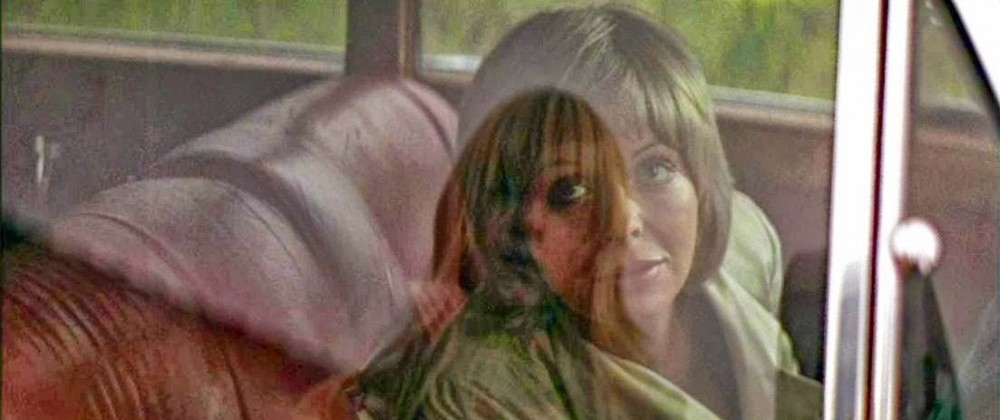
Images (UK-USA, 1972) 101 min color DIR: Robert Altman. PROD: Tommy Thompson. SCR: Robert Altman; In Search of Unicorns, by Susannah York. DOP: Vilmos Zsigmond. MUSIC: John Williams, Stomu Yamashta. EDITOR: Graeme Clifford. CAST: Susannah York, René Auberjonois, Marcel Bozzuffi, Hugh Millais, Cathryn Harrison. (Columbia)
UPDATE! A little context. This article was written when Robert Altman’s Images, plus a few other key Altman titles, were notoriously hard to find. Things have changed since. A few years later, MGM released it to DVD; Arrow would release it to Blu-ray; as of 2023, it can be viewed on Tubi! Therefore, some of the text below (ie- “will never be legally available…”) will seem preposterous now. However, I’ve decided to leave the bulk of this article as is, if to show readers what we had to do in the old days to acquire obscure film titles.
Robert Altman’s 1972 psychological film Images is one of the most sought-after films which is not available on video. Single copies of gray market VHS dubs can net a lot of money on eBay. The reasons for why this film is not available to rent on video (or for that matter, to view in revival houses) are somewhat obscure, however it is widely believed that Columbia accidentally destroyed the negative. Therefore, whatever small hopes one has for seeing this film at all comes from being able to track down any surviving film prints. Why now this interest in Images? Perhaps it is due to the retrograde interest in 1970’s cinema.
Viewers of my generation missed the Hollywood Renaissance by a few years (instead we came of age in the Breakfast Club era– oh joy), and therefore had to educate ourselves vicariously– chiefly, by catching a lot of these key films on television. (The video revolution was only starting to creep itself into people’s living rooms at that point.) Therefore, once one happens upon the huge catalogue of Robert Altman, and then wants to check out more work of this diverse author, one is surprised to find that some of his key titles are still missing from view– Three Women or California Split may be on TV occasionally, but neither are on video. Thanks to the Internet, people are now creating video dubs of suspect quality, and selling them to eager fans who would never have a hope of seeing them otherwise.
Images is to me one of the Holy Grails of Cinema– one of those elusive titles which will never be available on video (legally), which one may see once in a lifetime in a Cinematheque, or which can be tracked down in the good old gray market. Les Affaires Publiques, Fear and Desire, We Can’t Go Home Again… obscure films which you build up in your mind due to their elusiveness, and which may or may not reward you once you’ve finally tracked them down. I’ve now seen Images three times, and I still don’t know what to think of it.
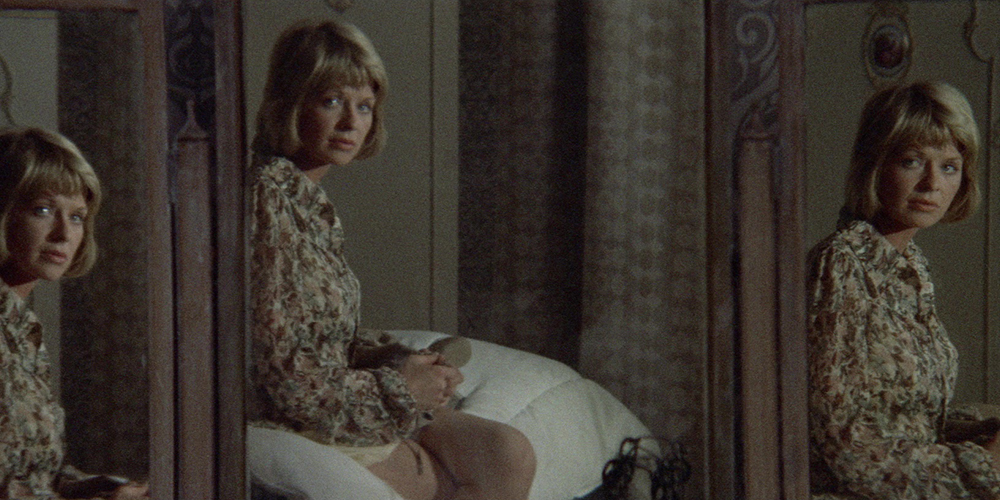
It is a classical Altman movie– a collision of images and sounds. It is a very busy film, yet one is never certain if it is really going anywhere. It may be a deceptively simple film told with much complexity, it may just simply be a movie which is all window dressing with nothing inside, or maybe it’s just so complex that I might need a few more screenings to peel all the layers. Those few who did see Images in 1972 didn’t know what to think of it, either. The film closed quickly, and was largely forgotten. However, it has its defenders.
In some ways it is a missing link in his filmography. All of his 1970s films dissected film genres. Images was the closest he came to a psychological horror film. This movie has been compared to That Cold Day in the Park, and Three Women, because all three titles are small-scale projects (compared to his typically sprawling canvases with numerous plots and characters), and they also attempt psychological studies of women going crazy. However, Three Women is a much more lucid character study. That Cold Day attempts to be a psychological drama but it is too muddled… too boring, even. Images is certainly more opulent, yet all of its energy and seemingly dense structure make one think that it isn’t as profound as it wants us to think, yet even so, it is interesting brain candy all the same. Images is often compared to Repulsion, which also features a woman cracking up, leading to murderous tendencies.
People who hate Altman often accuse his work of being sexist, as they always feature women in helpless and/or neurotic roles. I see it, but by the same token, few male filmmakers like Altman offer such risk-taking roles for actresses– from Karen Black in Come Back to the Five & Dime Jimmy Dean Jimmy Dean to Julianne Moore in Short Cuts, women get the chance to explore other parts of human behaviour that most mainstream films ignore. Sometimes these characterizations can be embarrassing, and certainly unflattering, but they are facets of human nature whether we care to acknowledge them or not.
Susannah York is Cathryn, who lives in a country home with her husband Hugh (René Auberjonois). She sees apparitions of her dead lover René (Marcel Bozzuffi). To further complicate things, they are visited by their friend Marcel (Hugh Millais), and his daughter Susannah (Cathryn Harrison), who may or may not be a manifestation of Cathryn as a young girl, or perhaps a future inkling of Cathryn’s unborn child. Glancing at the cast and character’s names, you notice that the actors’ first names are also the names of someone else’s character. This is a typically Altmanesque way of reminding you that you are watching a movie, yet also this subtle move makes perfect sense. At the film unfolds (or is it wrapping tighter?), the characters start to collide. Cathryn even begins to see herself in shadowy rooms. To add a further layer to this overlapping study, Cathryn is reading from a book, In Search of Unicorns, which Susannah York actually wrote.
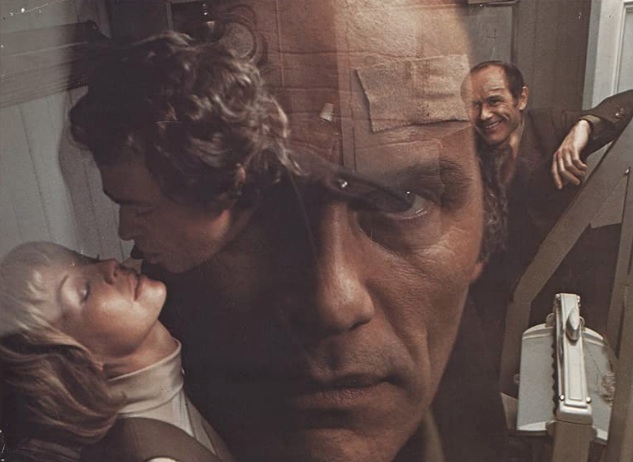
There are many scenes in which the writer-director tries his hand at horror tropes. He avoids camera trickery, as segments are done merely with unbroken takes. We see René in the doorway, the camera pans to the mirror which reflects the doorway, and now we see Hugh. It’s all timing of course, but its natural presentation turns it nonetheless into a magical feat. Yet this film evolves from whatever Cathryn is reading in the beginning– the entire film is in her head. Dream logic is a risky achievement in filmmaking– a cryptic, seemingly hazy exposition may just simply be careless writing. Even if things do not work in literal terms, there is still some kind of central idea which must unite all of these strands. In this film, it is perfectly acceptable that these characters overlap (not only in the names of their players’ cohorts), and that we see Cathryn “seeing herself” in bed and on a roadside. When she sees these apparitions (of René or herself), the viewer later learns that another “real” character was in their place instead. This provokes questions as to what these two characters have in common– why is she is confusing one for the other? Or, what is it of herself that she sees in others?
It may be that Altman isn’t remaking Repulsion, but perhaps Meshes in the Afternoon. In Maya Deren’s classic experimental short, we see three Maya Deren’s in one frame– each one represents some unique of her personality. Therefore, René, Hugh and Marcel could all be aspects of her personality– they aren’t physical people. And one once considers that the film ends where it began (reading the end of the children’s book on the soundtrack, a jigsaw puzzle with a unicorn being completed as the final image), none of this may have existed in the “real” world at all. The images even flow together in the same way that the mind connects one thought to the next (water from a shower blurs into an overhead shot of a waterfall).
This may be classically considered to be a study of one woman’s descent into madness, but in fact, Images could be about an already mad woman who frees herself from her constrictions. Seeing her laughter in the eerie, second-to-last scene after a murder has (maybe?) taken place is Cathryn’s only onscreen moment of happiness.
You have probably noticed that this review is full of “maybe’s” and “perhapses”. Altman has created a maze, yet he has also closed the door to the exit. One keeps going around in circles, finding new corners to explore, hoping this new one will be the key, only to find that this too is another facet of the puzzle. Vilmos Zsigmond’s cinematography further adds to the hazy narrative (I mean this positively). Shooting in Ireland’s rainy, misty meadows, often in drab monochromes, and framing with selective focus (in which parts of the screen are obscure), the great cameraman has created a dense, unnatural world. Plus, John Williams’s score and (especially) Stomu Yamashta’s thunderous sounds (weird electronic noise, chimes) create an uneasy feeling within this world.
For all of that, Images is a dense (or is that empty?) puzzle of a movie which may mean everything and nothing. I can’t tell if this is a movie which is rich in meaning or so muddled to hide its shallowness. It may be a misfire; it may be a masterpiece.
Originally published in Vol. #1, Issue #10 (“Summer in the 70s”)
Greg Woods

Greg Woods has been a film enthusiast since his teens, and began his writing "career" at the same time- prolific in capsule reviews of everything he had watched, first on index cards, then those hardcover dollar store black journals, then an old Mac IIsi. He founded The Eclectic Screening Room in 2001, as a portal to share his film love with the world, and find some like-minded enthusiasts along the way. In addition to having worked in the film industry for over two decades, he has been a co-programmer of films at Trash Palace, and a programmer/co-founder of the Toronto Film Noir Syndicate. He has also written for Broken Pencil, CU-Confidential, Micro-Film, and is currently working on his first novel. His secret desire is for someone to interview him for a podcast or a DVD extra.