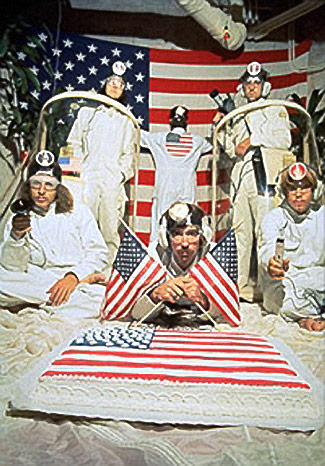
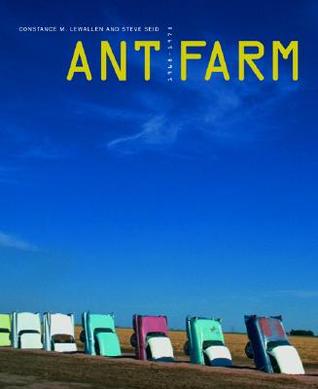
Ant Farm was considered to be one of the most important art-media collectives during its reign from 1968 to 1978. Within those years, they created a large catalog of works spanning across several disciplines: architecture, installations, “media events” (a then-modern translation of the 60s term “happenings”) and a new medium called “video”. (Since this is after all a film publication, we will obviously be concentrating on the latter.) In 2003, Ant Farm received a generous revival for a new era- being feted in a multi-city tour, with an accompanying catalog (Ant Farm 1968-1978, published by University of California Press). For those who missed the retrospective, this book is the next best thing. It is beautifully illustrated with diagrams and colour plates featuring their most famous works, and also has several long, scholarly texts, each devoted to one of their many disciplines. Still, for all of the insight and accolades that properly suits the tone of the book, amidst all the academia, perhaps the editor was remiss about one important ingredient. Despite all of the ideas that went into their work, first and foremost, Ant Farm was FUN.
In 1968, Ant Farm was founded by a fun-loving group of hippies, with Chip Lord, Curtis Schreier and Doug Michels as the core members. The name “Ant Farm” was chosen for its dual reference to the kids’ toy (in which one could see ants scurrying around digging tunnels through sand while encased in plastic), and for the communal name that it implies. Much of their work has been inspired by their fascination with such post-war America symbols as automobiles and televisions.
In short order, they would convert a bus into their self-styled “media van”, equipped with state-of-the-art hardware, so that these Merry Pranksters would hit the road with their new-fangled Sony Portapak (shooting on half-hour long 1/2” black-and-white video tapes, costing 20 bucks a pop), documenting any peculiar or spontaneous moment that caught their eyes. Ant Farm Video, the DVD released by Facets, is certainly valuable for showing the tongue-in-cheek approach to their work. While the disc contains some of the group’s most celebrated video pieces (The Eternal Frame is glaringly absent), much of the DVD features video work intended as visual records of their work, more than being standalone pieces, per se.
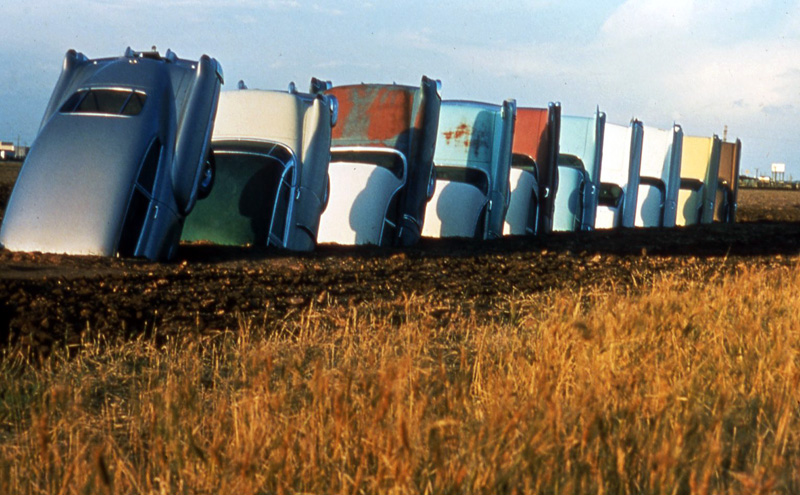
Perhaps their most famous work in any medium is “Cadillac Ranch”, a 1974 “installation” along the fabled Route 66, featuring a bunch of cars half submerged into the earth. Later to be rhapsodized in song by Bruce Springsteen, this is the archetypal statement of how car culture has invaded the homeland. With the oblique angles in which the cars are half-buried, this piece is also as much modern art as it is delightfully absurd. The Facets DVD features a 1994 reunion, celebrating the 20-year reunion of those involved, including the colourful cowboy emcee Leo Wyoming, a bit older, but still master of ceremonies. (This reunion video fittingly features the Springsteen song, but not without much wrangling with Columbia records, who wanted royalty fees. The singer then stepped in and just let them use the song, in honour of their work inspiring him in the first place.)
Another fascination of The Ant Farm was futurism— however their vision of tomorrow wasn’t the typical glass and steel, which had dominated much of then-modern architecture. Rather, their concept of future living was of soft plastic inflatables, favouring round edges over lines. The 1971-73 installation, “House of the Century” is a classic example of that. This structure recalls a two-storey igloo, or a high-rise on the planet Tatooine. And despite how forward-thinking this invention might be, this soft, plush living arrangement is perfectly of its time, complimenting the archetypal 1970’s laid-back hedonistic lifestyle. On the Facets DVD is the short Inflatables Illustrated (1971), in which Curtis Schreier (surely the “Ringo” of their group if there was one) demonstrates how to make these plastics of the future.
Their fascination with the future was also exhibited in the Ant Farm Time Capsule, a video which covers the 2000 “grand opening” of a refrigerator from the 1970s which the Ant Farm stuffed with consumer artifacts of the day—not just snacks like Coca Cola or Planter’s Peanuts, but household products such as Raid, Lysol and STP! This interesting video is a cousin to their magnum opus Media Burn, in which the collective brilliantly creates a momentous media event out of something so absurd. The coup de grace of the video is of course the unveiling, to see how these diverse cultural artifacts have “become one”, as they are all covered with mould. (In there is symbolism somewhere.)
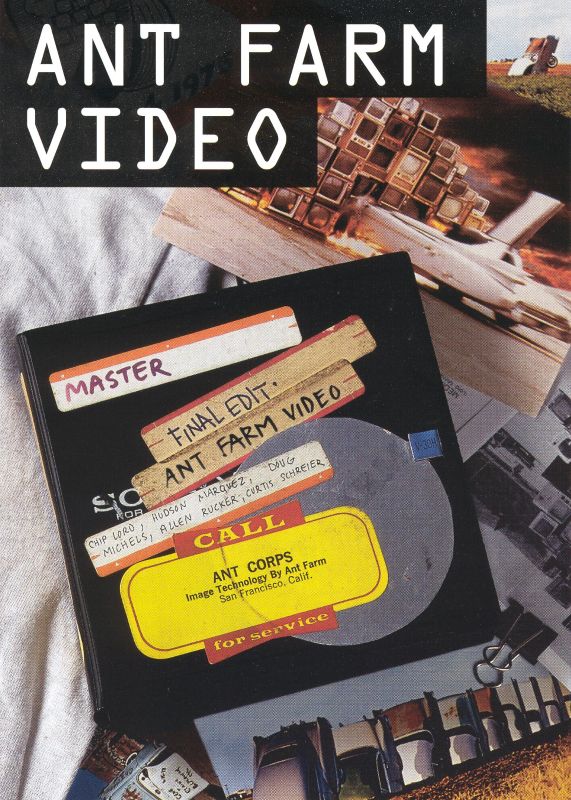
Off-Air Australia (1976) is a compendium of off-air recordings of TV appearances, and documents of performance pieces from their 1976 Australia tour. The first half of this amusing collection features lively talk-show appearances of the group and their “technological pet” Ajax, (a neon face hooked up to an appliance, instead of a live animal, since bringing the latter on an airline was prohibited) and giving the audience hats made out of yeast and aerosol, which would gradually change colour. This video culminates in a performance outside the Sydney Opera House, as these Marx Brothers of the art world perform their opera “Car-men” (get it?), with Schreier in his kangaroo suit (get it?), conducting people to honk their car horns and rev their engines in synchronicity. This sequence is made even funnier as it is shot and edited like countless concert videos of the following decades, including the inevitable helicopter shot spiralling over the vista of the opera house.
But for all that, this DVD is also valuable for its vintage videos, which emphasize their fascination with the immediacy that this new medium brings. For example, Dirty Dishes (shot in 1970, edited in 1978), is a diary video of the most lo-fi kind (including credits on a piece of cellophane), shooting various members of the collective at various times around the communal dinner table (and, it should be noted, the subjects are in varying states of mind), featuring such spontaneous moments as Chip Lord cracking up on camera, performances with figurines, and, lest we forget, “The Topless Talk Show from Topanga” as friends appear on camera imitating colourful folk from the most subterranean corners of middle America.
The World’s Longest Bridge (1970) is a 20-minute video consisting of a single unbroken shot for the entire piece, recorded from the dashboard of the media van, as the Ant Farm travels across the bridge over Lake Pontchartain, in Louisiana. The camera blurs in and out of the destination ahead, slowly zooms or pans to the equally placid water while the van lumbers along. On the soundtrack is this childlike music played on a recorder, the formlessness of the music complimenting the “found” images on screen. How cinematic this is depends on one’s sensibilities, but after a while, this trance-like experiment becomes addicting, and is certainly more visually arresting than anything by Warhol. This video is surely a benchmark for this new electronic medium, showing the possibilities of shooting fluidly for such a long period.
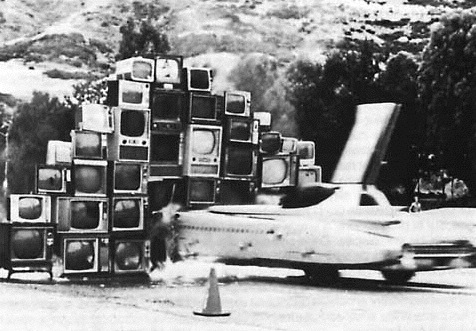
But of course, the pinnacle of this DVD collection is the inclusion of their brilliant 25-minute video Media Burn (1975), surely one of the best shorts I’ve ever seen in any medium. With each passing year, this video becomes more relevant in its satanic presentation of American consumerism, and its depiction of the shallowness of media coverage.
The Ant Farm strategically planned “Media Burn” on a July 4th weekend, “because nothing else is going on that is newsworthy”, and invited various news crews to come check out this peculiar publicity stunt, featuring their Phantom Dream Car (a revamped 1959 Cadillac Eldorado) driving through a pile of TV sets. This video is perhaps the most apocalyptic expression of their post-war fascinations, as this event culminates in an explosion, sending the ultimate exponents of post-war culture to hell.
What makes this video even more (sickly) funny is the inclusion of artist Doug Hall as President John F. Kennedy, who makes the inaugural speech. Media Burn thusly becomes a close cousin to their equally infamous video The Eternal Frame (1975), which re-enacts the JFK assassination in Dallas, also featuring Hall as the president. The Zapruder home movie footage is perhaps the most famous and certainly most important piece of post-war American film, not just for the endless scrutiny that has been given it by historians and conspiracy theorists alike. For the simple fact alone that this fateful moment of history transpired in a car, one can see the Ant Farm’s fascination. But the passing of the movie star president and the closing of his own Camelot perhaps signalled the end of the innocence surrounding the post-war dream.
For Media Burn, it is somewhat fitting to see the ghost of JFK usher in these proceedings. It is to suggest that his return to the natural world is a corrective to show how the land of the free has spiralled out of control. Amidst his elongated speech of hyperbole and dated rhetoric about Americana, his words are peppered with such telling phrases as “Haven’t you always wanted to throw something at your television?”
After his ceremony, two of the Ant Farm members don asbestos suits, man the automobile and crash the car through a barricade of televisions. In a montage that predates any Simpson-Bruckheimer epic of the next two decades, this act is repeated numerous times from various angles, to further wallow in the celebratory nature of this destruction. Before the fiery crash, “JFK” finishes his speech with the prophetic: “Many will not understand what happened today, but none will forget it.”
Media Burn also appropriates footage culled from various news broadcasts having covered the crash, with vapid anchormen muttering, “Well that was weird.” And thus we sense that this event was created solely as a practical joke for those who accepted their invitation and attended, thus buying their prank- hook line and sinker. Media Burn similarly documents the carnival-like nature of the proceedings, with starlets dressed in proverbial red white and blue selling stickers and program guides to this put-on in disguise. This movie-within-a-movie, documenting the event as well as incorporating other source footage, is a sly commentary on the skin-deep nature of our media, the anchormen dismiss this event as a fluff piece, and ignore the complexity of ideas behind it.
In 1978, the Ant Farm headquarters caught fire, in which many, but surely not all, of their works were destroyed, prompting the group to call it quits. Over the years, this collective of multi-disciplinary artists has been remembered for their audacious pieces that lampoon their era, as well as celebrate their perverse fascination with it. Despite that video was one of the many media that they explored, Ant Farm created enough innovative works on it to be considered pioneers of the form. The Facets DVD is a valuable introduction to the novice. Now, if ever they re-release it, would someone please add The Eternal Frame?
Originally published in Vol. #1, Issue #20, “Independent Voices”. Alas, the DVD is out of print, but The Eternal Frame can for the moment be viewed online.
Greg Woods

Greg Woods has been a film enthusiast since his teens, and began his writing "career" at the same time- prolific in capsule reviews of everything he had watched, first on index cards, then those hardcover dollar store black journals, then an old Mac IIsi. He founded The Eclectic Screening Room in 2001, as a portal to share his film love with the world, and find some like-minded enthusiasts along the way. In addition to having worked in the film industry for over two decades, he has been a co-programmer of films at Trash Palace, and a programmer/co-founder of the Toronto Film Noir Syndicate. He has also written for Broken Pencil, CU-Confidential, Micro-Film, and is currently working on his first novel. His secret desire is for someone to interview him for a podcast or a DVD extra.