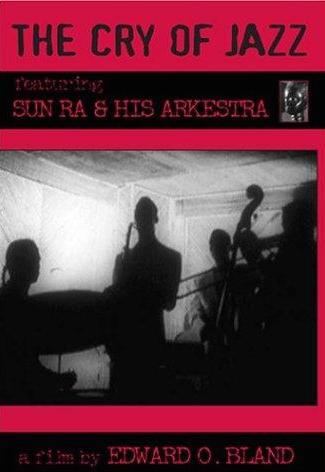
The Cry of Jazz (USA, 1959) 35 min B&W DIR:Edward O. Bland. PROD: Edward O. Bland, Nelam L. Hill. SCR: Frank McGovern, Eugene Titus, Madeline Tourtelot, based on The Fruits of the Death of Jazz, by Edward O. Bland. MUSIC: Eddie Higgins, Norman Leist, Julian Priester, Paul Severson, Sun Ra. DOP: Hank Starr. EDITOR: Howard Alk. CAST: George Waller, Dorothea Horton, Melinda Dillon, Andrew Duncan, Laroy Inman, James Miller, Gavin McFadyen. (MDV / Atavistic)
This 35-minute film is being released on DVD with a huge banner stating that it features Sun Ra and the Arkestra, and it does… for a second or two. More accurately, Sun Ra was helpful in getting the picture made. But don’t let this dissuade you from seeing this film. It is actually a thought-provoking meditation on jazz music’s correlation with the Black Experience.
Musician, composer and lecturer Edward Bland directed this short film, unseen for ages, whose framework is an intellectual discussion at a party between black and white people about jazz. Particularly, the articulate Negro Alex (George Waller) explains to his white friends that as much as white people appreciate jazz, they can never understand what the music truly means.
In essence, jazz is an expression of joy from its players, “a reaction to America’s ceaseless attempts to obliterate him.” The film is replete with gritty footage of impoverished black ghettos to communicate the oppressive surroundings, and conversely performance footage of jazz and gospel (one of its close cousins) shows the performers’ emancipation from it. And during that brief clip of Sun Ra, Alex mentions that “Sun Ra’s music is what the negro’s experience was, is, and what is going to be.”
For all that, the film unfortunately suffers in these wraparound scenes at the party. Some of the Caucasian actors emote their lines on the level of an educational film performer blankly reading cue cards. But there is a sadness to this picture, in that the more we listen to Alex’s prose, the more we realize he is right, even in this age. Alex’s white friends take offence to some of his comments- in this case, the truth does hurt. The human race may have advanced somewhat in multicultural relations, but we still have a long way to go.
Originally published in Vol. #1, Issue #16. Update! In 2010, this film was selected for preservation in the United States National Film Registry by the Library of Congress as being “culturally, historically, or aesthetically significant”.
Greg Woods

Greg Woods has been a film enthusiast since his teens, and began his writing "career" at the same time- prolific in capsule reviews of everything he had watched, first on index cards, then those hardcover dollar store black journals, then an old Mac IIsi. He founded The Eclectic Screening Room in 2001, as a portal to share his film love with the world, and find some like-minded enthusiasts along the way. In addition to having worked in the film industry for over two decades, he has been a co-programmer of films at Trash Palace, and a programmer/co-founder of the Toronto Film Noir Syndicate. He has also written for Broken Pencil, CU-Confidential, Micro-Film, and is currently working on his first novel. His secret desire is for someone to interview him for a podcast or a DVD extra.