
The Violent Years (USA, 1956) 57 min B&W DIR: William Morgan. PROD: Roy Reid. SCR: Edward D. Wood Jr. MUSIC: Michael Terr. DOP: William C. Thompson. CAST: Jean Moorhead, Barbara Weeks, Art Millan, Theresa Hancock, Joanne Cangi, Gloria Farr, I. Stanford Jolley, Timothy Farrell. (Headliner Productions)
Once upon a time, the fledgling auteur Edward D. Wood Jr. sold a screenplay (for about $800) in between writing and directing his own mad mini-epics. The resultant work, The Violent Years, was rediscovered in the infancy of the video age, just when there was a renewed, posthumous interest in his career after revivals of Plan 9 from Outer Space and Glen or Glenda. Even today, one can see why everyone got so thrilled about the resurrection of a forgotten Ed Wood movie. Like any other film borne under his pen, this one features his trademark wild dialogue, and a curious revision of 1950s societal mores. Ed Wood may have been inept, but he clearly had a great deal to say for himself. Glen or Glenda was a plea for the acceptance of transvestism; Bride of the Monster and Plan 9 were slaps at the atomic age. The Violent Years is as an interesting gender bender to the tropes of “troubled teen” pictures, in which females are the aggressors. What other film in the McCarthy era has a man being sexually assaulted by women?
The story begins at the end. Judge Clara (played by serial bad guy I. Stanford Jolley) berates his two friends Jane and Carl Parkins for their incompetence in raising a child. Their daughter, pretty, precious Paula (Jean Moorhead), is their little angel by day, and at night leads a quartet of girls in a spate of robberies and various debaucheries. In this prologue, (predating Godard by about six years) the audience can only see the back of mom’s head (thereby denying us any chance to see any of her humanity) and hear her morose voiceover: “Didn’t I give her everything?”
Sure, Mom (Barbara Weeks) gives Paula a blank cheque in place of a heart-to-heart talk… and newspaper editor Dad (Arthur Millan) -who is covering the very stories his daughter has germinated- has to send someone to drop off a gift for Paula because he’s chained to his desk. 1950s white picket fence suburbia and executive life are equally upturned to see the ugly truths beneath. In one half of the hour-long running time, Paula and her gal pals hold up gas stations, rob a couple in Lover’s Lane (and have their ways with the male), throw a make-out session with men who are clearly too old for them, sell goods to their double-crossing fence, and even trash their high school (the ultimate sign of punk rebellion).
As with the opening sparse courtroom scene, the film’s ending is summarily devoid of compassion. Its voice over and cross-like shadow of jail bars are of a minimalism that would seem at home in Bresson! And yet, in between, this is an exploitation fan’s dream picture.
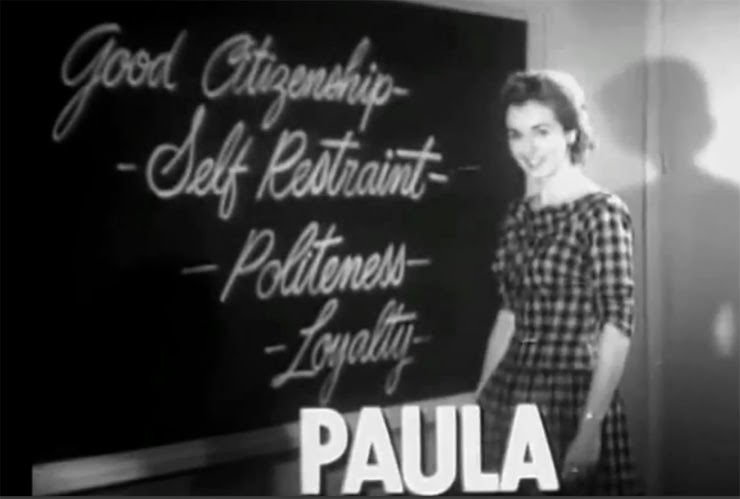
While daring for its subtext (yes, that Lover’s Lane scene is still shocking in context), The Violent Years is a prime Grade Z relic of its era. That irresistible sequence where the four girls are introduced: each walks up to a blackboard with scrawls of “Good Citizenship” and “Self Restraint” snub their noses at it, and walk off. This sleazy bop music plays incessantly (the same hardboiled sax and piano doing a knockabout “Blues Alley” riff), underneath some dry narration that attempts to make this exploitation educational (and it is… for different reasons). The dialogue is spoken in the tone of The Little Rascals saying “Oh yeah?!?” before there’s a fight on the schoolyard. The famous exchange (“I killed a police-man tonight.” “A cop?” “Yeah a cop.”) has become as legendary as “Pull the strings” from Glen or Glenda, or the “somebody’s responsible” tract in Plan 9. Add good old Timothy Farrell (Glen or Glenda, Jail Bait, Dance Hall Racket) doing his usual world-weary, unsmiling tough guy routine, newspaper headlines such as “COUPLE ON LOVERS LANE CRIMINALLY ATTACKED” (read that again), washed-out underexposed night photography by good old William Thompson, which suits the film perfectly, the worst broken glass matte job in movie history, and you have an irresistible time capsule of 1950s exploitation masquerading as “social cinema”.
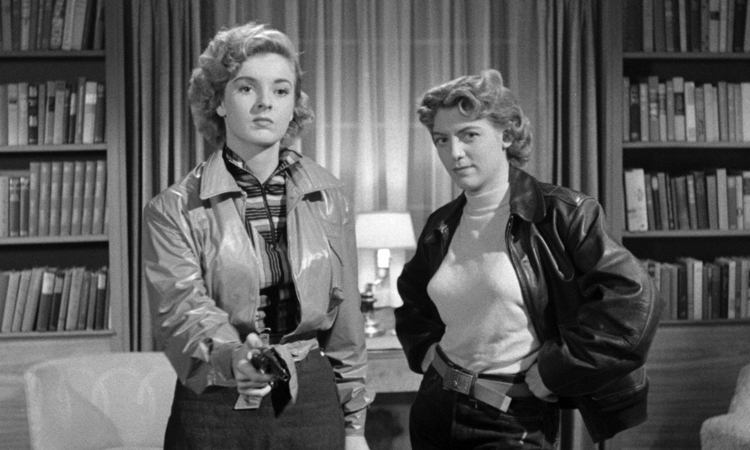
We may laugh at the crazy dialogue, but we don’t overlook the subversive quality of wholesome young women being the perpetrators of such deviance. (I love how Dad’s co-worker drops off a gift during Paula’s make-out session.) In an hour, Ed Wood sends the nuclear family to hell, and overturns 1950s sexual politics. Around the same time, Wood was writing and directing his own JD saga (Hellborn) which was never completed in his lifetime. The Violent Years therefore stands as a good example of how the “problem teen” genre is dissected by Grade Z cinema’s favourite spacey visionary.
Originally published in Vol. #1, Issue #6, “The Second Annual Summer Drive-In Issue”.
Greg Woods

Greg Woods has been a film enthusiast since his teens, and began his writing "career" at the same time- prolific in capsule reviews of everything he had watched, first on index cards, then those hardcover dollar store black journals, then an old Mac IIsi. He founded The Eclectic Screening Room in 2001, as a portal to share his film love with the world, and find some like-minded enthusiasts along the way. In addition to having worked in the film industry for over two decades, he has been a co-programmer of films at Trash Palace, and a programmer/co-founder of the Toronto Film Noir Syndicate. He has also written for Broken Pencil, CU-Confidential, Micro-Film, and is currently working on his first novel. His secret desire is for someone to interview him for a podcast or a DVD extra.