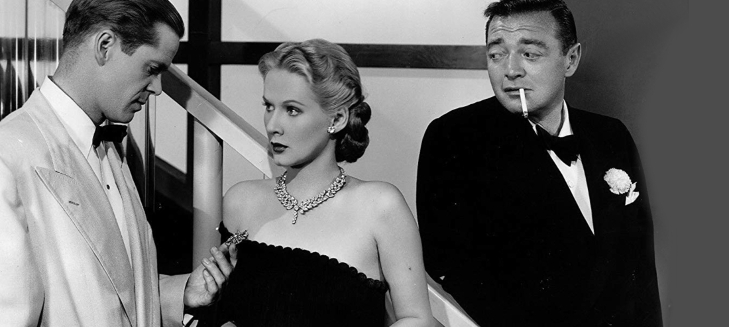
Black Angel (USA, 1946) 81 min B&W DIR: Roy William Neill. PROD: Tom McKnight, Roy William Neill. SCR: Roy Chanslor, based on the novel by Cornell Woolrich. MUSIC: Frank Skinner. DOP: Paul Ivano. CAST: Dan Duryea, June Vincent, Peter Lorre, Broderick Crawford, Constance Dowling, Wallace Ford, John Phillips. (Universal)
Based on a novel by renowned pulp author Cornell Woolrich (Phantom Lady, Rear Window), Black Angel was the final entry in the lengthy filmography of distinguished director/producer Roy William Neill, who devoted the bulk of his energy in the 40s to directing and producing entries in the popular Sherlock Holmes series. Neill’s parting shot was an accomplished cut-rate excursion into noir territory, a wrenching suspense drama that alternately floats on a seductive song and sinks in an alcoholic pool of despair.
Adapted from Woolrich’s novel by screenwriter Roy Chanslor, Black Angel elegantly weaves a dark romance of unrequited love, lust, and inebriated anguish, set in motion by the sinister murder of a fatally seductive femme fatale. The film’s colourful locales are an exercise in sharp contrast, as the action moves from the upper floors of luxurious apartment buildings and ritzy nightclubs to the gutter of cheap whisky joints and flea-bitten flophouses. Fate and a murder committed in the heat of passion bring together a motley group of characters whose intentions are often suspect and at odds with each other, while the law mercilessly prepares to mete out it’s death sentence to the presumed killer.
Dan Duryea (Scarlet Street), a noir regular known for his heavy-handed on-screen treatment of women, plays lead character Martin Blair, a talented but booze-hungry songwriter who yearns to reunite with his estranged wife, celebrated singer Mavis Marlowe (Constance Dowling). When Blair shows up at Marlowe’s regal apartment building on the night of their anniversary, the haughty femme fatale has him turned away at the door, while another suspicious character is allowed to pass (Peter Lorre’s smooth-talking nightclub owner Marko). Blair storms out, and staggers through a series of lowlife taverns on a furious drinking binge, attempting to drown his sorrows. He is later found pounding away on a cheap piano by the manager of his low-rent hotel, and is dragged to his room to sleep it off. Meanwhile, a third male visitor, Kirk Bennett (John Phillips) arrives at Marlowe’s lavish apartment, only to find her dead body on her bedroom floor. Bennett is spotted as he flees Marlowe’s residence, and the police pin him for the murder, much to his wife’s shock and dismay.
Catherine Bennett (virtuous blonde June Vincent) sets out on an urgent quest to prove her husband’s innocence, and soon finds her way to the squalid lodgings of Martin Blair. Reluctant at first, Blair becomes enchanted with Mrs. Bennett’s wholesome charms, and the two begin their own investigation as Kirk Bennett sits on death row. When Blair recognizes Marko, the owner of upscale Sunset Strip nightclub Rio’s, he and Mrs. Bennett devise a plan to gain access to Marko’s inner sanctum. The couple go undercover as a musical act (Blair on piano with Mrs. Bennett filling Marlowe’s former role as singer), and are booked into Rio’s; Marko wastes no time in making advances on his club’s newest songbird. Mrs. Bennett’s hopes of proving Marko guilty are dashed, however, when Marko finds her breaking into his office safe, and the conspirators’ true identities are revealed. The police arrive before anything serious happens, and Blair Mrs. Bennett are back to square one, with Marko now out of the picture. As time runs out for Bennett, Blair realizes that Mrs. Bennett is devoted to her husband, and does not reciprocate his doomed love for her. In a fit of despair, he hits the bottle again, and embarks on another drinking binge through a series of seedy watering holes. Picked up after a brawl, Blair is thrown in an asylum to ride out his bender; strapped down to a bed, he relives the night of the murder in a hallucinogenic flashback, uncovering the true identity of the killer. In a pulse-quickening finale, the despondent Blair sacrifices himself for Bennett’s freedom, presenting the police with hard evidence that will reunite the married couple, while leaving himself no exit.
Black Angel is a respectable outing, with an engaging narrative that shifts from darkness to light, optimism to despair, keeping the viewer suitably mystified until the climax. The second-tier status of this overlooked film noir is belied by its impressive camerawork, lighting, set design, editing, and its evocative, melancholy score. The film opens with an ambitious establishing shot: the camera first focuses on Duryea standing at street level, then follows his upturned gaze to Marlowe’s apartment building, travels up the building’s outer wall and enters her apartment through the window (effectively recreating a famous shot from King Vidor’s silent classic, The Crowd). Duryea’s nightmarish flashback sequence towards the end of the film is also very inspired, giving an expressionistic treatment to the dark, emotionally-charged images that ripple and shimmer in his feverish mind. The use of suggestive, patterned shadows and high-contrast lighting helps define the film’s noir environment, with vertical and horizontal lines strategically delineating numerous shots (even mirrored in Vincent’s outfits). Strong performances by Duryea, Vincent, and Lorre also elevate the picture above the standard “B” thrillers of the day. Black Angel’s melancholy tale will haunt your memory long after its images fade from your screen.
Originally published in Vol. #1, Issue #13 (“Noir”).
David Faris

David S. Faris is a Toronto-based writer, musician, DJ, and graphic designer. He has written articles and reviews for music magazines Chart, Exclaim!, and Blue Suede News. He is also a founding member of the Toronto Film Noir Syndicate.