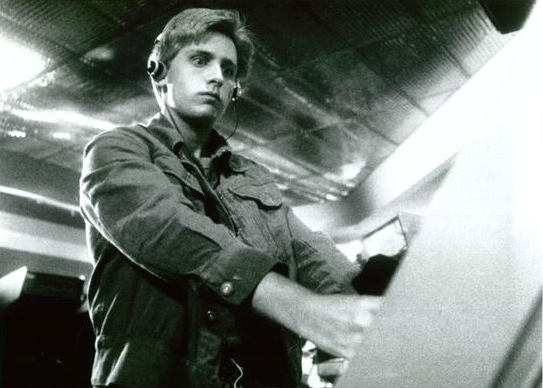
In the burgeoning field of video game studies, theorist, and video game champion Jane McGonigal wrote a book called Reality is Broken: How Video Games Can Change the World. In it, she posits that the notion of the “Epic Win” in video gaming (that is those moments requiring great skill, where you’re maneuvering your hero/character/whatever through a situation of insurmountable odds, to reach the end triumphant) have real world benefits, aiding in building self confidence, hand eye coordination and more. This has led to a whole field called “gamification”, where the reward systems from video games are moving into the real world and elements of gaming are popping up in education, marketing, business etc., as a way to give incentive to real world behaviour. But prior to the rise of theorists such as McGonigal, this concept of the “Epic Win” was felt in the heyday of arcade culture, and it made its impact on nearly every other form of media from the late 70s to the early 90s.
Needless to say, the influence of video games on our culture is far reaching, and it is making inroads all the time. As an industry, it now makes more money than the film/tv/music industries combined. But gaming culture’s influence is not a new phenomenon- since the dawn of the video arcade and home video game consoles, they have featured prominently in all manner of film and television. And by looking back at the role video games have played in other popular media, we can see not simply its ubiquitous nature, but also arguments for and against gaming culture through the execution of some of these works. As much as cinema, even fictional narratives provide us with all manner of thrill, emotion, and entertainment, so too do they read like historical documents, not simply telling us about their stories, but in and of themselves becoming documents that speak to the times that they were made in. They tell us about who we were at a particular point in time, our passions, our values, our fears and our anxieties.
80s film and TV were rich with references to game culture, mostly due to the arcade’s status as a mecca of youth culture. These were not simply places where kids went to play games, but they were also social hubs, where friends would meet, socialize, spend time together and of course play together. At its height there was an arcade in nearly every mall, in every neighbourhood, and failing that there were cabinets at movie theatres, variety stores, bars and more.
While the richest, regular and most direct associations with game characters were the Saturday morning cartoons such as Saturday Morning Supercade (featuring Donkey Kong, Pac-Man, Pitfall, Q-Bert and more in short animated, anthologized adventures) or Captain N: The Game Master (little more than a marketing move by Nintendo of America in which a young boy gets sucked into videoland, which is conveniently populated by mascot characters from various Nintendo franchises). Even Spider-Man and His Amazing Friends introduced a villain-come-hero in the way of Video Man, a pixelated hero born out of an arcade cabinet at a local video arcade.
It was through film and television that we were privy to the influence of game culture beyond the marketing machine of Saturday mornings. Countless films featured arcades as a set piece or backdrop for a scene: The Karate Kid, Terminator 2, Back to the Future, Big, Better Off Dead, Fast Times at Ridgemont High and yes, even Death Wish 4.
But while we could see it everywhere, there are films that placed arcade culture in the foreground of the narrative rather than a set piece or background for which to film a scene. While there are a wide number of films that featured games as part of their plot, there are three in particular I want to focus on; three films from different genres that all place the arcade square in the middle of it all; three films that in their own right give their own commentary on the conflicted perspectives surrounding arcade culture and in an of themselves make a value judgement on its position in culture at large.
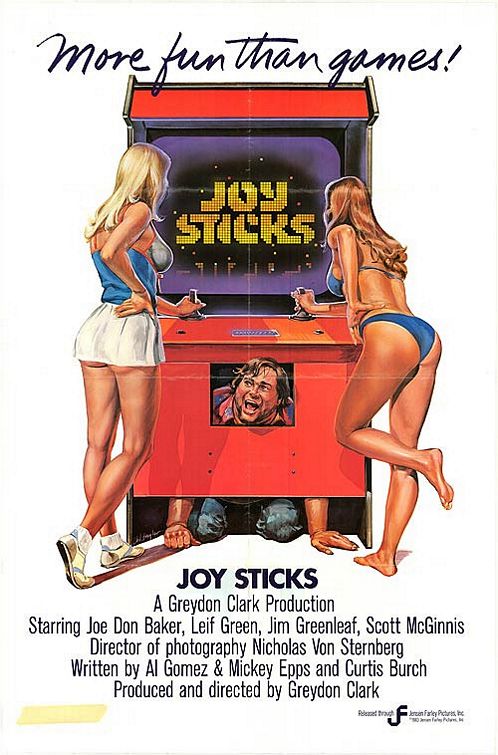
The first is Joysticks (1983) from Greydon Clark, the man behind Satan’s Cheerleaders, and it appears to be the second of some kind of weird Joe Don Baker trilogy (both the film he made previous to Joysticks, Wacko, and the film after, Final Justice, feature Joe Don Baker in lead roles). Joysticks is one of those totally campy early 80s flicks that’s a nihilistic romp that features echoes of Footloose, Meatballs and Ski School.
It all centers around an arcade in a non descript town called cleverly enough “Rivertown”, a town chocked full of every wacky 80s comedy stereotype we know. There’s the young Patsy (Corinne Bohrer), who speaks in that ever so recognizable valley girl dialect, her evil father Mr. Rutter (Joe Don Baker) whose personal quest it is to shut down down the arcade, the loveable nerd Eugene (Leif Green) who works at the arcade under the “supervision” of pretty boy manager Jefferson Bailey (Scott McGinnis). There’s King Vidiot (played by one of my favourite character actors Jon Gries, whose role as Lazlo Hollyfeld in Real Genius being among his most memorable for me) dressed in punk garb and make up as if he just left a Klaus Nomi concert, and there’s Dorfus, the former high school class president turned slovenly and obese video game wizard. Oh, did I mention the bumbling cousins, who try to do Rutter’s dirty work?
Take all these stereotypes, mix them up and you have a film with a loose plot, gratuitous nudity, hair-brained schemes hatched, thwarted and re-hatched, and you’ve got Joysticks. You see, Mr. Rutter thinks that the arcade is a centre for all sorts of depraved behaviour for the local youth, and countless times throughout the film he comes to the arcade, snatches his daughter up, throws her in his car, takes her home and schemes to shut the arcade down. His bumbling cousins try to steal all the machines in the arcade only to fail, then comes the town hall/ ad hoc trial where Rutter tries to convince the mayor to shut the arcade down. At each turn Rutter’s actions are met with wacky schemes by Jefferson and his crew to save the arcade.
The film’s climax features a video game battle between King Vidiot and Jefferson in a head to head game of “SuperPac”, which was a permutation on the PacMan franchise. Thing is, Jefferson has lost his gaming edge because of an incident years before that he can’t get over involving his former girlfriend and her father, which takes place in one of the most laughable scenes I’ve seen in a long time. Imagine a giant plush bed, two young lovers in it, surrounded by candles, in a video arcade! I daresay that this is probably the only candlelit video arcade scene in cinematic history!
The Video “Arena” as they call it feels like the progenitor to the classic video game showdowns in the Fred Savage vehicle The Wizard, but it’s more absurd. Each competitor stands on a lit platform and has to manipulate SuperPac by using the world largest joystick- it is so big that the ball atop the stick is an actual bowling ball!
Needless to say that Jefferson finds his inner strength, beats Vidiot, saves the arcade and all is well in teen nihilism land once more. I find this film interesting for a number of reasons, mostly due to the continued pleading of the “morally superior” father figure, who insists on the depraved behaviour of the arcade’s inhabitants. And yet, you have those inhabitants claiming that the arcade is a wholesome communal spot where any youth and come and feel as if they belong, that playing games is what unifies them over clique or social group. My problem is that the actions of these characters in the film are totally nihilistic, self centred and depraved. You can say something is otherwise, but if the actions of the characters in the film keep leaning towards that behaviour, well, it’s sort of hard to empathize with them.
This film does show the arcade as the social mecca that I mentioned earlier, filmed in the “Golden Age” of the video arcade. But it’s really cliché; and in spite of its attempts, it undermines its own arguments about the value of the arcade. I understand that this is a genre film that sticks to a very specific formula, one where young girls remove their tops at the slightest provocation, where hijinks and shenanigans are the order of the day, and where the youth will revolt and they will win. But with a script this banal, acting that’s just as banal and predictable, I actually found myself looking in the background to see what games cabinets populated the arcade, oddly for me, that was where the film’s true value lay, in the historical documentation of the arcade machines themselves. Certainly not what the filmmakers intended.
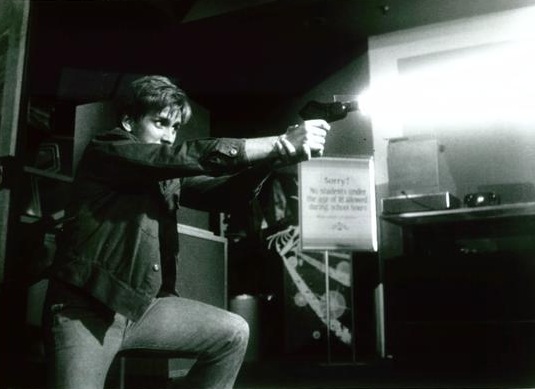
Which is the perfect lead in to a rather cautionary tale of arcade culture. The Bishop of Battle is a short horror(ish) that is part of a larger anthology film called Nightmares that was released in 1983. It revolves around a young J.J. Cooney (played by a Emilio Estevez prior to his “breakthrough” role in Repo Man the following year), a young video game wizard/ hustler who travels to inner city arcades to play other gamers for money. The film opens with J.J. and his boy sidekick entering a downtown LA arcade to hustle some stereotypical 80s latino tough guys out of their money, only to be chased out of the arcade, and through the streets (they narrowly escape by catching a bus). But there’s a reason J.J. is trying to raise funds.
Back at his local mall (in the Valley), there’s an arcade machine that’s very special. The Bishop of Battle!! J.J. Has never been able to make it to the fabled Level 12 in the game and he’s so determined to do so, that he hustles other gamers out of their money, only to feed it into the Bishop’s coin slot. The game itself is rather odd, and was clearly made just for the film. It is the only game (as someone online stated) that has both a joystick and a gun. It also features some very nice looking vector graphics, that were obviously influenced by Tron, which came out the year before. J.J’s first battle with the Bishop (in which he must navigate a maze and shoot all the enemies) in the film ends with him losing (as usual) and the arcade closing, so there’s nothing to do but go home. Enter the parents who don’t understand their son and his love of those time-wasting games. His grades are slipping, his attitude is getting worse, and all he wants to do is play those “damn” video games. This argument, presented by J.J.’s father is the same alarmist attitude that Mr. Rutter seemed to possess in Joysticks, that John Lithgow’s character possessed in regards to dancing in Footloose, and I’m sure I could ring off countless other examples.
It’s the illustration of new media/ forms of expression that the previous generation struggles to understand, while the current one adopts and embraces it. It’s Rock ‘n’ Roll in the 50’s. It’s the invention of photography. There is always a hysteria and so called moral objection to any new form of media as it is born and matures. Here, J.J’s father is that voice. And while normally I would argue it’s simply alarmist b.s., well, the Bishop of Battle is something to be cautious and concerned about.
We skip ahead to find J.J. sneaking out of his room and breaking into the arcade after hours to challenge the Bishop once more. And this time, he bests him. He gets to level 12 and beats even that, which is when things go haywire. The cabinet rocks and forth, smoulders, then explodes. Suddenly a small ray gun appears on the floor, and the vector graphics rendered sprites from the game spring forth from the ruins of the arcade cabinet and begin shooting at J.J. Suddenly his obsession has turned real, and his desire to play games has leaped out of the arcade and into real life. He runs, dodges shoots until he ends up in the parking garage of the mall, at which point he is surrounded.
Then the Bishop himself appears (a vector based face much like the computer at the end of Tron) and tells him that he has lost. It gets closer and closer, J.J. screams. Fade to Black. We then come back into the arcade, where the Bishop of Battle machine has been miraculously repaired, the arcade owner, a police officer, J.J.’s young sidekick and J.J.’s parents all enter the arcade looking for him. And find him, they do. Trapped inside the screen, inside the maze in the Bishop of Battle game.
So here’s a cautionary tale of how obsession can possess you. This more than any other game-related film I’ve seen from the 80s really comes off as feeling anti-game by the end of it. Even though the design of the fictional game graphics and enemies are very well done, and even though it tries to show us a slice of that youth culture again by way of several arcades, it’s all filtered through J.J.’s obsessive lens. And it’s only at the end of it all that he sees the error of his ways, from inside a video game monitor. This is one film that leaned heavy on the father’s anti-game speech, and at the story’s Twilight Zone-like conclusion, I swear I heard the quietest whisper of “I told you so” as it faded to black.
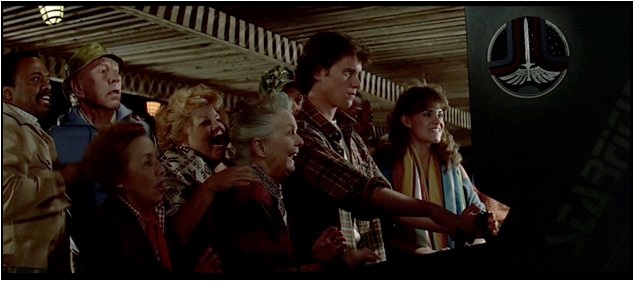
While J.J. came close to what Jane McGonigal dubbed the Epic Win, he didn’t quite make it, but there’s one film protagonist who accomplishes that feat, both in the game realm and in the reel world. In The Last Starfighter (1984, perhaps my favourite year in film) mild mannered trailer park teen Alex Rogan dreams of life beyond his humble existence. His only real escape being an arcade cabinet at the park called Starfighter. I will always remember the dialogue from the game: “Greetings Starfighter- you have been recruited by the Starleague to defend the frontier from Xur and the Kodan Armada”.
Alex has so little going on that he plays this game all the time. In fact there’s so little that seems to happen in this trailer park that when he’s on the verge of breaking the game’s high score that the entire population of the community is there cheering him on. And yet, even though he does accomplish this feat, he still yearns for more. Enter Centauri, a charming if shady character who arrives in a futuristic car to recruit young Alex, for you see, Starfighter was not just a game, it was a recruitment tool, sent out to all corners of the galaxy to find candidates to become actual StarFighter pilots. * as a side note here, I wonder if someone from the US Military saw this film in the 80s and used it as the inspiration to create America’s Army, a free combat based video game that the army now uses as a recruiting tool.
Alex gets whisked off to Rylos, and joins the Star League, only to be so overwhelmed by everything that all he wants to do is go home, however after getting back he realizes he’s erred and wants to rejoin the myriad of alien races he encountered to defend the galaxy. But by the time he gets back to Rylos, the evil Xur has already attacked and destroyed all but one Starfighter and has wiped out all the other pilots. Thus making him the Last Starfighter.
In many ways this film is of another “Star Wars boy comes of age travels off into the cosmos to grow up and become a man and save the galaxy” sort of films. This whole journey of the boy to the hero was everywhere in 80s science fiction film. Lucas really had something that grabbed onto the imaginations of young boys (such as myself; to place it into context I saw Star Wars when I was 4, Empire when I was 6, Jedi when I was 8, and then Starfighter at 9). Films such as these were a huge part of my childhood, mostly due to the action figure marketing machine that accompanied them (although prototypes were made for figures for The Last Starfighter, they were never released).
In fact when I think about these sci-fi movies, they too all had video games that were spawned after their releases, except (ironically) The Last Starfighter. Apparently it didn’t do all that well and the marketing never really got behind it, and while there was a prototype game made, it was released by Atari as a sequel to a previous space shoot em up called Star Raiders.
So while Alex may have had his epic win in the game and by defeating the evil Kodan Armada in the film, that is where it ended for him. Although he does choose to live on Rylos rather than return home, so that he can help rebuild the Star League (leaving room for a sequel, which sadly never happened).
What I find most interesting about all of these films is that they really do make their positions on gaming culture known, and pretty explicitly. This is interesting, because these same arguments are still part of the popular discourse surrounding video games even now, a dialogue that began nearly 30 years ago and it feels like there hasn’t been much movement on either side. It’s either that they’re detrimental or beneficial, often without giving clear indications as to why (much like in the films). I suppose you could argue that Joysticks does show us a nihilistic world of topless girls, oversexed teens and a new level of consumption culture (pumping coins into machines) all the while trying to preach its message about community and belonging (although having spent much time in arcades when I was younger, I can actually say that the community part is quite true). Meanwhile you have the Bishop of Battle, which reads more like a young man’s struggle to control his impulses and obsessions more than it is a condemnation of arcade culture, even though the father’s speech in the film does make that point rather explicitly. And finally we have The Last Starfighter telling us that of course games aren’t a waste of time, they’re training for some possible fantastic combative trip to the stars! Again this leaves me to shudder a little when I think of this movie’s connection to the America’s Army game.
Recently I began graduate school, and I’m planning on focusing my research on gamer culture, but also where it intersects with other elements of our pop spectrum, be it movies based on games, games based on movies, you know that whole idea of convergence culture. But I’m really enjoying looking back at the films of 20-30 years ago, maybe it’s because not only these are the films I grew up with, but I also grew up with arcade culture. I saw its rise, and fall. The films of this era that really captured that culture for posterity. So by looking at these films, I’m not simply getting a healthy dose of film nostalgia, but a nice dose of retro-gaming nostalgia as well.
Originally published in Vol. #1, Issue #24.
Skot Deeming

Skot Deeming is a pop culture commentator and enthusiast, who has written about media and culture in various fields; including film, television, new media art, video games and art toys. His artwork has been exhibited internationally and his writing has appeared in academic, mainstream and independent publications. Currently, he’s living in Montreal, working on his PhD centered on the cultural economies of character licensing, appropriation art, and toy cultures. Find him at: Instagram (@yoyodynetoydivision)