One of the hardest things to achieve in cinema is that delicate balance in stories that blend fantasy and reality without appearing too heavy-handed or pretentious. The films of director Sara Driver are successful in this and many other things. Her work reminds us that the most magical moments in movies are those elements of fantasy that are so matter-of-fact, and presented with deceptively simple means.
Ms. Driver began in cinema working behind the scenes on the first two films of her spouse Jim Jarmusch (Permanent Vacation; Stranger Than Paradise), all while forging her own style, as evidenced in her first effort, the short film You Are Not I (1981). Both filmmakers rose from the No Wave Cinema movement that typified the New York underground in the late 1970s to early 1980s. They absorbed its “do-it-yourself” aesthetic, yet each would explore techniques that differed from No Wave’s usual Surrealist-shock value, homages to trash culture, and Orwellian themes. While her more famous spouse would create an instantly recognizable oeuvre of deadpan, minimalist works, Sara Driver’s films would be noted for their quirky humour, and liberal doses of fantasy (or irrationality) injected into realistic settings.
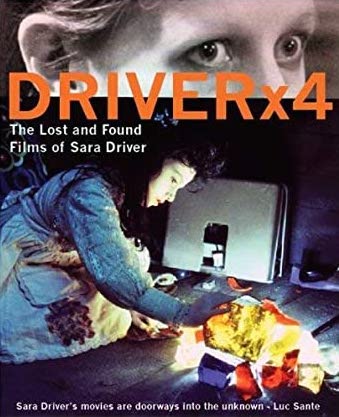
A unique gift for DVD collectors this year is the long overdue release of Sara Driver’s films on a set from Ron Mann’s distribution company, Films We Like, entitled DriverX4 – The Lost and Found Films of Sara Driver. To many, the jewel of the collection would be her debut work, You Are Not I. This acclaimed adaptation of a 1948 Paul Bowles story single-handedly gave recognition to Ms. Driver as a unique talent. However, it would soon disappear from view, as the negative was destroyed in a warehouse flood, and her copy would deteriorate over time. For years, it was feared that the film was lost, until a print was discovered in the Paul Bowles estate. This resurrection no doubt influenced a retrospective of her work in the festival circuit, and its eventual release to video. The DVD collection includes all four of her films as a director (minus one TV episode of Monsters): the last produced nearly 20 years ago.
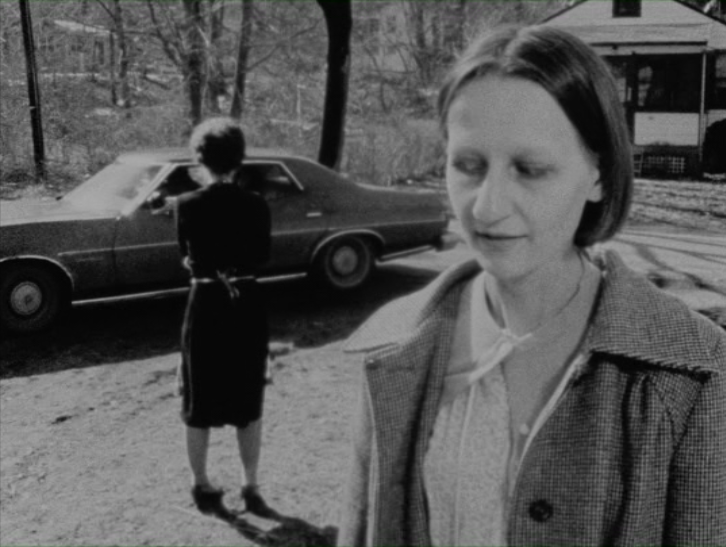
The 48-minute featurette You Are Not I (1981) is a languid, cryptic, sometimes disquieting drama of a woman named Ethel who escapes a mental institution. She manages to get out into the free world when attention is diverted by a multiple car accident nearby. She surveys the dead victims draped under blankets by the roadside, and begins to put a stone in one corpse’s mouth (interesting allusion to old world folklore), until she is led away by a worker at the crash site.
It is assumed that Ethel is a victim of the accident, and is taken to her sister’s house nearby. Once Ethel is dropped off, her sister at first assumes that she has been released from the institution. However upon further examination of Ethel’s demeanour, it is apparent that she couldn’t have been discharged.
Shot in glistening black and white by Jim Jarmusch (who also adapted the screenplay with Ms. Driver from the short story), You Are Not I is as much a part of Bowles’ literary world as it presages her own film work. Ethel guides the movie: she is in every scene, and the narrative is often accented by her voiceover. (There is minimal onscreen dialogue.) Since we are viewing a world that is experienced by an unstable person, the film correctly wavers between a dream state (emphasized by the ethereal, gritty cinematography) and the real world.
With this debut effort, Sara Driver has already mastered the ability to blend unnatural things into our physical world. Even for a work of forty-eight minutes, there is little narrative action, and really only two scenes. The languid pacing and minimal editing force us to explore further the world that may only exist in Ethel’s mind. This environment is further given an otherworldly feel by the fascinating industrial drones of the soundtrack by Phil Kline. (He and Jarmusch were in the No Wave band, the Del Byzanteens.) Ethel’s narration also adds to unease in passages like “the outside much like inside—someone is telling you what to do”. It becomes as difficult for Ethel and viewer alike to distinguish one world from the other.
The flow of the movie is disrupted twice, by sudden cuts to black, which inform abrupt shifts in the narrative. The first occurs when she is mistakenly driven to her sister’s home; the second occurs near the end when the film cleverly introduces a role reversal (hinted at by the title). As the film fades, however, we are still uncertain about whose world we are living in, and the clarity of the voice that has been guiding us.
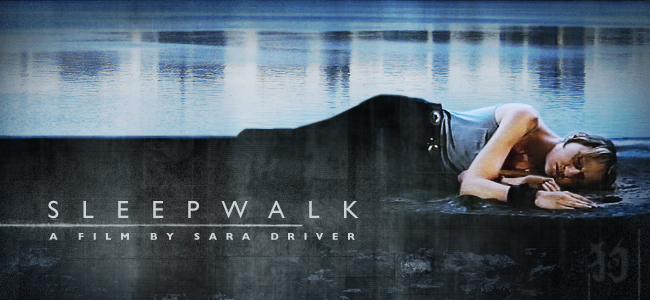
As Ethel, Suzanne Fletcher is astonishing: her deep set eyes, bulbous nose and haunted expression contribute to her unusual screen presence. She would reunite with Sara Driver in the 1986 feature, Sleepwalk, as Nicole, a typesetter in a small Lower Manhattan print shop. She is offered an unusually generous sum of money by the mysterious Dr. Gou (Stephen Chen), and his African-American assistant (Tony Todd, pre-Candyman), to translate a Chinese text of nursery rhymes.
As she works after hours on the texts (which she is also instructed to constantly have in her sight), strange phenomena occur in her life and those close to her. Her roommate, the selfish good time girl Isabelle (Ann Magnuson) loses her hair. A girl named Ecco Ecco arrives at the shop to warn Nicole of the texts, and is later found dead prior to their agreed-upon rendezvous. Dr. Gou’s office is full of almonds (people regularly comment on their scent while in presence of the manuscript). Nicole’s Asian son Jimmy (Dennis Lee) inadvertently becomes kidnapped after her car is stolen while left unattended by Isabelle on a trip to Atlantic City, as Nicole is working.
Before and behind the camera, this effort features familiar names of the New York underground. Ann Magnuson, a fixture in the downtown scene, plays the screeching Isabelle; as cinematographer of this elusive affair, Jim Jarmusch begins the first of his collaborations with Steve Buscemi. Then still a bit player for independent New York films by Eric Mitchell and John Sherwood, and years before landing his great comic role in Jarmsuch’s Mystery Train, he can be glimpsed briefly checking slides at the print shop. Still, with its relaxed pace, sparse editing and Eastern-sounding score by Phil Kline, this film paints Lower Manhattan with a different texture than one would be accustomed to seeing in other films of the period. The shock and trash aesthetics common to the day’s No Wave Cinema are substituted for a quiet, poetic tone; the milieu is instead of empty streets, suggesting a Manhattan that exists while the club scenesters slumber. This gritty world of warehouse spaces, hot apartments, and dingy bars is given a slightly unnatural feeling thanks to the bright cinematography. It turns this urban landscape into a surreal playground where the supernatural moments don’t feel out of place.
This enigmatic narrative, written by Driver, Kathleen Brennan and Lorenzo Mans, is for the most part captivating viewing, as one surrenders to the strange goings-on that intervene in Nicole’s life. Like any true phenomena, much of its purpose is unexplained, however because the unnatural moments seem so at home in the world that has been created, one doesn’t mind. If one were to loosely attribute a literal meaning to this obscure tome, it is that in some way, the price paid for consorting with the text is that Nicole and those in her orbit lose something dear to them: Isabelle loses a symbol of her vanity; Nicole loses her son.
The film’s only great flaw is when the kidnapping drama unfolds. Because Isabelle is an illegal alien, she couldn’t report the theft of the car or the abduction to the police. Despite the supernatural goings-on in this film, the characters in this movie are still real people, not figurative (rather, they are three-dimensional characters who have symbols enacted upon them). Therefore it is absurd (and infuriating) that Nicole does nothing after hearing the news about Jimmy except going out on the street and calling his name, implying that the megalopolis of New York is as small as a neighbourhood block.
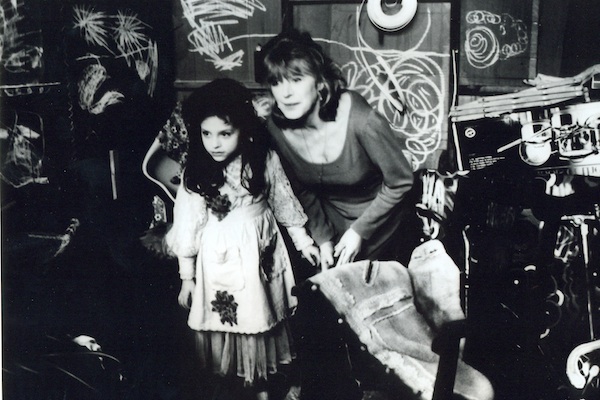
Supernatural occurrences are played for laughs in the 1993 oddball fantasy, When Pigs Fly. Marty (Alfred Molina) is a jazz musician whose life is turned around when he is visited by ghosts of a little girl (Rachel Bella) and an older woman (Marianne Faithfull!). As with Sleepwalk, Sara Driver depicts a world that already exists somewhere between fantasy and reality. (All of the film’s effects were done in camera, further blurring that line.) Thus when the ghosts become prominent in the narrative, they hardly seem out of place.
Early on, while Marty slumbers, he dreams about living a life with luxury and women. (Even his dog has a similar dream!) This sequence is filmed with bright secondary colours contrary to the greyish palette that cinematographer Robby Muller aptly uses to depict Marty’s waking life of lower-working class milieu, bad hangovers and limited prospects. Further, there is a wonderful extended sequence with Marty and his pupil sitting on the piano bench, flying above the city (literally) into greener pastures. (Fittingly, the music played is Thelonious Monk’s “Misterioso”.)
This scene exemplifies the transcendent power of music, especially while heard in a half-asleep state of mind when one’s own consciousness surrenders to irrationality: rendering the body weightless, transporting one to the other world that this aural cinema has created. Perhaps Marty’s occupation as a jazz musician is also symbolic, as one remembers the supernatural milieu of the music by such diverse artists as Lester Bowie or Albert Ayler, and how the origins of jazz are rooted in mystical lore.
On the surface, When Pigs Fly is as quirky as a typical early 90s indie project. The tone is uplifted by a Celtic score from Joe Strummer during his Pogues period (he was also an actor in Jarmsuch’s Mystery Train). There is also the clever gag in which the ghosts can only travel within the vicinity of a chair that Marty is given, so therefore they freely roam into the real world by tying parts of the chair to their bodies!
As much as When Pigs Fly effortlessly finds the balance between reality and fantasy, it also finds the correct blend of comedy and drama, without resorting to overdone satire. Although the picture has an oddball tone, the harshness of Marty’s world is still vividly portrayed. In spite of the elaborate revenge plot that later unfolds, this movie is above all about love, as the ghosts are still benevolent in their poltergeist mischief. Indirectly, their sabotage helps the patchy romance between Marty and his barmaid girlfriend Ruthie (Maggie O’Neil), and finds a resolution to Ruthie’s problems with her verbally abusive boss Frank (played by indie movie darling Seymour Cassel).
Although Alfred Molina has had a long career, perhaps he is best remembered to the average moviegoer for playing cads in Raiders of the Lost Ark and Spiderman 2. Here he is marvellous as Marty, the well-meaning but perpetual underdog screw-up. No matter how well done or literate the supernatural shenanigans are, this scenario wouldn’t work without his great comic energy.
The boxed set includes a fourth Sara Driver piece that is perhaps the most personal: the ten-minute videotape, simply entitled Bowery – Spring 1994, which depicts the New York Bowery era in its waning days. This short experiment is also a vital component of her work on several levels. Like When Pigs Fly, this video is also a ghost story (one soundbyte: “the bowery lives on as a domain of ghosts”). The spirits in here however are abandoned buildings and memories, which are among remnants of the New York Bowery era.
The narrative is guided by Luc Sante, author of Low Life: Lures and Snares of Old New York, (also the man who carries away Ethel from the crash site in You Are Not I) who offers a history of the Bowery, and illuminates some of the still-standing highlights in its decline to a Skid Row.
Amidst such cultural icons as CBGB’s, Joe Coleman’s Odditorium Museum and such dubious historical sites as McGurk’s Suicide Hall (a hotel where old prostitutes would go and kill themselves by swallowing carbolic acid), one views the mosaic of street life in the foregrounds of these structures that get increasingly dilapidated and covered with graffiti and handbills.
There is a Runyonesque feel to the portrayal of the assorted crazies and street artists who anonymously appear. Although one is always witness to squalor and the potential for danger, this piece is also about love, and the odd fraternity among its inhabitants.
This fascinating piece was fittingly made at the end of Driver’s filmmaking career, when the No Wave scene had already become a memory. It is also a reminisce of the harsh urban milieu reflected in that scene. With the Disneyfication of New York, and even the gentrification of The Bowery, this landscape too has become a memory. Bowery – Spring 1994 hauntingly depicts the end of an era.
As of this writing, Ms. Driver is doing the screenplay for and co-directing an animated anthology film Tales from the Hanging Head, scheduled for release in 2014. In this age where CGI is so commonplace that special effects hardly seem wondrous anymore, it will be interesting to see if this fantasy film reverts to her techniques evidenced in these films: pure movie magic that Sara Driver’s work seems to effortlessly display.
Originally published in Vol. #1, Issue 25. UPDATE! As of 2021, Tales from the Hanging Head remains unrealized. Since then Sara Driver has worked on two films that look back on the downtown New York scene. She co-produced the documentary Uncle Howard (about the late filmmaker Howard Brookner) and directed Boom for Real: The Late Teenage Years of Jean-Michel Basquiat.
Greg Woods

Greg Woods has been a film enthusiast since his teens, and began his writing "career" at the same time- prolific in capsule reviews of everything he had watched, first on index cards, then those hardcover dollar store black journals, then an old Mac IIsi. He founded The Eclectic Screening Room in 2001, as a portal to share his film love with the world, and find some like-minded enthusiasts along the way. In addition to having worked in the film industry for over two decades, he has been a co-programmer of films at Trash Palace, and a programmer/co-founder of the Toronto Film Noir Syndicate. He has also written for Broken Pencil, CU-Confidential, Micro-Film, and is currently working on his first novel. His secret desire is for someone to interview him for a podcast or a DVD extra.