This piece is serialized into several parts. In case you found this page by chance, the article begins here.
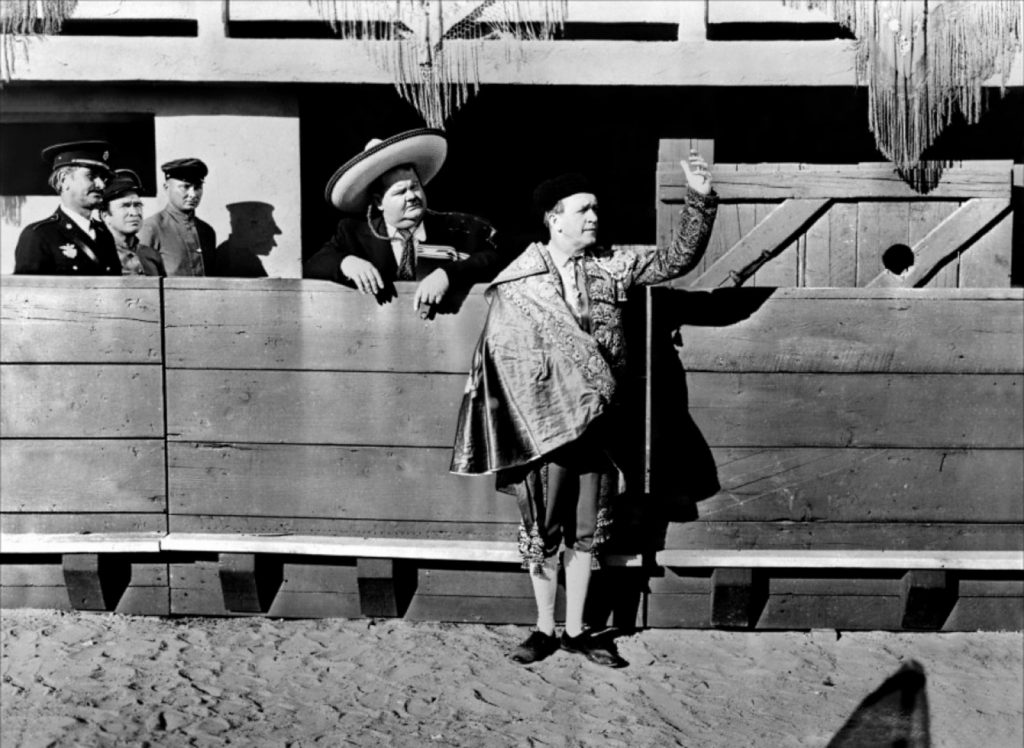
For their final Fox effort, The Bullfighters (1945), Scott Darling’s screenplay relies upon the double identity gimmick used in the boys’ earlier Roach film, A Chump at Oxford. This time, Stan and Ollie are police officers who travel to Mexico to extradite a crook named Hattie Blake, otherwise known as Larceny Nell. Meanwhile, a fight promoter named Muldoon (Ralph Sanford) meets with agent Hot Shot Coleman (Richard Lane) about his client, the famed matador Don Sebastian. Muldoon is stunned to realize that Sebastian resembles Stan Laurel, one of the two idiotic detectives who sent him to jail for erroneous testimony. Once it is learned that Sebastian cannot make the fight due to passport complications, Coleman blackmails Stan into doubling as Sebastian, or else he’ll reveal his true identity to Muldoon, who has vowed to skin those two alive if he ever crosses paths with them again.
Those who usually pan the other Fox films usually have good things to say about this film, even author Scott MacGillivray. Truthfully, The Bullfighters is a mediocre affair that relies too much on tired gags such as their old handshake routine, or the sound of a pin whistle at every instance that Stan kisses a girl. The scene where the detectives corner Larceny Nell (Carol Andrews) in a bar is overlong and uninspired. There are brighter moments near the beginning where countless people pile into one taxi, and when Ollie gets into a water fight with someone in a hotel lobby, but still this film feels longer than its scant 61 minutes. This feels more like a rushed second-feature quickie than any of their previous works. (It is one of those movies set in exotic locations that however have far too many signs in English.)
After their final effort for Fox, Stan Laurel and Oliver Hardy would not return to the screen until the early 1950s with the execrable Utopia (which also, incredibly, received positive notice in Scott MacGillivray’s book). Later in the decade, the comedians did plan to make a comeback with a series of specials that would return to their tested and true formula of the 1930s, as henpecked husbands with nagging wives. Sadly, after a diet which made him lose a dramatic amount of weight too quickly, Oliver Hardy passed away in 1957, before he and his old friend would ever act on this promise of new work. Stan Laurel passed away in 1965, as the appeal of their act would be discovered by a new generation of viewers thanks to revival houses and television broadcasts.
Now as then, Laurel and Hardy are the most beloved comedy act of the twentieth century. Their two decades of work with Hal Roach has solidified their reputation for all time. For surely as long, their Fox and MGM films will continue to divide their fans. It has been written by one of the team’s many historians that he is envious of those who, after seeing the Roach films, can still find something to enjoy in their subsequent work. Perhaps one’s judgment of these pictures depends upon how early in life they are viewed. If one sees them at an impressionable enough age, where point of view isn’t affected by any criteria or popular notion, one is more receptive to them.
This may be why I cannot fully bring myself to hate these pictures. Yes, their films from 1941 onwards are a considerable change from their glory days at Hal Roach, but by the same token, the world had also changed considerably since their jazz age / depression era comedies. They brought a form of entertainment that differed from their usual repertoire, but the audiences of this new decade also sought some escape from a different kind of reality than existed during their Hal Roach period. Even though sometimes they had difficulty in adapting their act to a wartime audience, the continued box office success of Stan Laurel and Oliver Hardy signifies their achievement. If one re-examines these pictures with those values in mind, the movies from 20th Century Fox and MGM do provide rewards.
Originally published in Vol. #1, Issue #25.
Greg Woods

Greg Woods has been a film enthusiast since his teens, and began his writing "career" at the same time- prolific in capsule reviews of everything he had watched, first on index cards, then those hardcover dollar store black journals, then an old Mac IIsi. He founded The Eclectic Screening Room in 2001, as a portal to share his film love with the world, and find some like-minded enthusiasts along the way. In addition to having worked in the film industry for over two decades, he has been a co-programmer of films at Trash Palace, and a programmer/co-founder of the Toronto Film Noir Syndicate. He has also written for Broken Pencil, CU-Confidential, Micro-Film, and is currently working on his first novel. His secret desire is for someone to interview him for a podcast or a DVD extra.