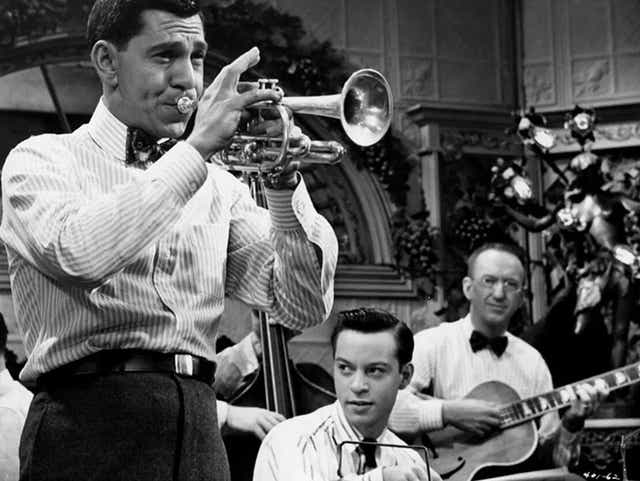
Pete Kelly’s Blues (USA, 1955) 95 min color DIR-PROD: Jack Webb. SCR: Richard L. Breen. MUSIC: Arthur Hamilton, Ray Heindorf, David Buttolph, Matty Matlock. DOP: Harold Rosson. CAST: Jack Webb, Janet Leigh, Edmond O’Brien, Peggy Lee, Andy Devine, Lee Marvin, Ella Fitzgerald, Martin Milner, Jayne Mansfield. (Warner Bros.)
While Jack Webb was making TV’s Dragnet, he bankrolled his own little pet projects (including the The D.I. and -30-). Pete Kelly’s Blues was made out of Webb’s great love for jazz. (Apparently he owned more than 6,000 recordings!) Few fictional movies about the art are worth their salt– Round Midnight and Sweet Love Bitter are among the exceptional films which truly understand the mind of a jazz musician. Pete Kelly’s Blues is not of this company, but it’s not for lack of trying. For a few moments anyway, it seems that this is going to be some big impressionistic piece, as we witness “a jazz funeral” in 1915 New Orleans, then a big jam blowout in 1919. We are thinking how this film will be about the evolution of jazz through its characters. Instead, we get another syrupy studio effort that plays more like a clichéd gangster picture with musical instruments. Jack Webb is trumpet player Pete Kelly (amusingly, he also does Dragnet-type narration throughout) who tries to hold his band together regardless of the many complications. (Look for movie tough guy Lee Marvin… as a clarinetist.) Chiefly, his combo gets strong-armed by mobster Edmond O’Brien (who is a bit much), who forces them to include his talentless singer girlfriend (Oscar-nominated Peggy Lee!) into the act. It shouldn’t be so surprising that for a 1950s studio picture about jazz, we just get another jazz movie about boring white musicians. (Mind you, Ella Fitzgerald does pop up in one scene.) Plus, the milieu of these hard-living musicians is sabotaged by all the splashy colour and big production values. (I am reminded of MGM’s version of A Christmas Carol, in which pauper-ish Bob Cratchit lives in a mansion!) For a slow Sunday afternoon, it’s okay I guess, but one wonders if Webb had more on his mind when he began this project.
Originally published in Volume #1, Issue #9.
Greg Woods

Greg Woods has been a film enthusiast since his teens, and began his writing "career" at the same time- prolific in capsule reviews of everything he had watched, first on index cards, then those hardcover dollar store black journals, then an old Mac IIsi. He founded The Eclectic Screening Room in 2001, as a portal to share his film love with the world, and find some like-minded enthusiasts along the way. In addition to having worked in the film industry for over two decades, he has been a co-programmer of films at Trash Palace, and a programmer/co-founder of the Toronto Film Noir Syndicate. He has also written for Broken Pencil, CU-Confidential, Micro-Film, and is currently working on his first novel. His secret desire is for someone to interview him for a podcast or a DVD extra.