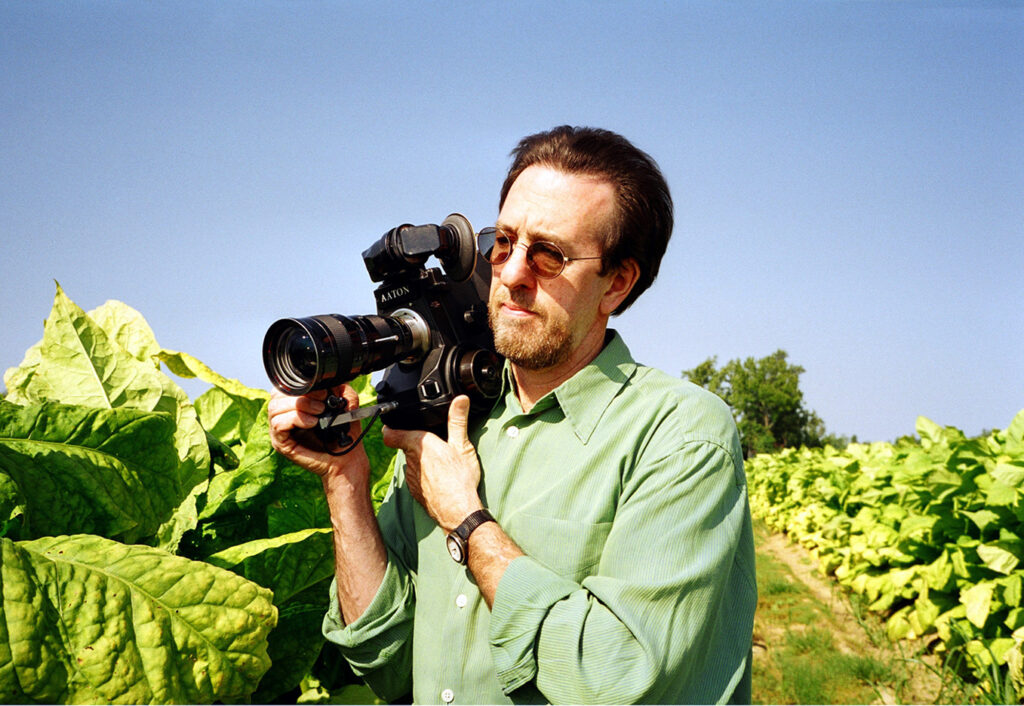
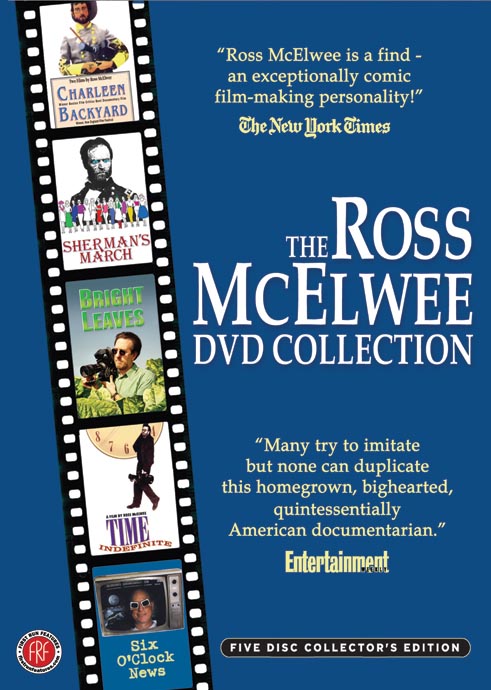
I’ve been living with Ross this past coupla weeks. Ross McElwee that is, the documentary filmmaker from Charlotte, North Carolina. That’s what box sets do- they let you live the artist’s life for a while. Day after day in a darkened room you look at the world through their eyes, seeing and hearing the edited activity, the slices of light and simulations of texture, the sensation of the lens as it limits the world with a succession of frames. The experience is art, not life, and the result is a wisdom driven, in McElwee’s case, with the sudden ripples of the unexpected, the unexpected being, amongst other non-traditional interruptions, batteries dying, film running out and subjects closing in for hugs ‘n kisses. The type of technical impasse which other filmmakers ruthlessly excise from the final cut McElwee revels in, as if life were constructed entirely from faux pas and his job was merely to indiscriminately record their progress.

Somewhere in the late eighties, that rather tawdry and best-forgotten decade, he broke out of film school obscurity and into the art house circuit with Sherman’s March (1987). I recall driving down to the Revue on Roncesvalles, the art house par excellence for years in Toronto, to view this most independent of documentaries purely on its program’s recommendation. And what an understatedly strange, iconoclastic little comedy it was. With the understated irony of a Woody Allen on a minuscule budget, McElwee toured “the south”, that icon of resistance in Yankee culture, trying to capture the essence of several enigmas he can barely define- southern womanhood, nuclear proliferation, the inner life of the notorious and seemingly quite neurotic General Sherman and the nature of romantic love. A tall order for a little guy with an apparently limited intellectual capacity, – a sly dumbing-down that Mr. Moore quickly learned -, but fortunately, when he’s not maundering through his inarticulate confusions in voice-overs that come across as connivingly artless, he lets the camera do the talking. Which it does, in spades. His one man operation looked and felt unique in its time, with perhaps only the Maysles Brothers’ Grey Gardens as a useful comparison in the annals of eighties eccentricity.
In the last decade or so, with the likes of Nick Broomfield and Errol Morris, such guerrilla filmmaking has come completely into its own as a full-fledged genre, with the disingenuous Michael Moore airlifting it into megabuck overdrive and the new armies of digital disciples duping themselves into a deeply undeserved authenticity. Once we had cinema verité, now we have cameras with attitude and second hand vision.
What a viewer discovers trawling through this McElwee box (from First Run Features) is that Sherman’s March was neither a fluke nor a wingy one-off arts grant indulgence. It was and is a foundation stone for his life’s work, an indispensable chapter from his oeuvre, and as necessary to understanding his contribution to the autobiographical documentary form as, say, The Decalogue is to Kieslowski. The ongoing project of documenting his life and times through the perhaps overly rosy and sentimental lens of family is what he will be remembered for. The most apt comparison is Michael Apted’s ongoing doc survey Seven Up (now at Forty Nine Up). Although quite different in style, Apted’s obviously the more conventional, the cumulative effect is startlingly similar: personalities unfolding through time and space, ripening through the dramas and comedies of their days and nights.
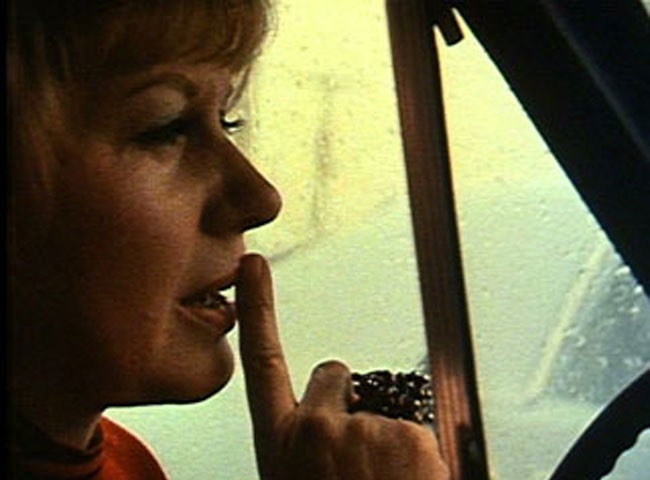
It could be argued that his former high school teacher and friend Charleen Swansea is the lynchpin to prying open the enigmas of McElwee’s craft. Not only is his first film of any appreciable length, Charleen (1978), devoted entirely to her life and innovative teaching activities, she is heavily featured in just about every other celluloid project that bares his name. And as she retains the vocal tones of a shrill, and sometimes shrieking, nagging harpy throughout one cannot help but wonder at the wisdom of McElwee’s choice. She’s the type of camera hogging control freak most directors would ditch on the first cut, but there she is, strutting through the various dramas and comedies of McElwee’s vision.
The most obvious and unfortunately Freudian answer is that she is a mother substitute figure for McElwee. As his birth mother, due to an early passing from this life, is perhaps the only close family member not to be repeatedly featured in these chapters of autobiography masquerading as documentaries, and as Ms. Swansea continually reappears throughout the screened decades as the advising/berating/ consoling female figure attempting to direct the director’s choices it is not much more than a no-brainer for first year psych students. But also there is no getting away from it, as her prominent cleavage juts and prods its way through many a sequence, commandeering any attentions not already swamped by her sing-songy shriek. The second, and perhaps almost as obvious analysis, is that her staccato soprano is a continual contrast to McElwee’s own soft, reassuring burr of a whisper, for while the voice-over narrates its dilemmas and confusions in a soothing whisper, her clamor is always unwaveringly certain.
Six years later McElwee produced Backyard (1984), a forty-minute portrait of his family and childhood home. Much of the Sherman’s March concept and style is premiered here. Walking about kitchen and garden, poking his lens at those who know and love him best, McElwee sketches in a first draft of his lifetime preoccupations- his father’s kindliness and devotion to the health of his patients, his brother’s decision to follow in his father’s footsteps and study medicine and his own determination not to stay in the south but to go Yankee and study film at MIT. Many sequences in Backyard are repeated throughout the later work, several more than once, making the entire set more like a diary with activated memories than anything else. Although a minor work, it is altogether essential to understanding the man’s preoccupations, which are essentially family and state. North Carolina, and its place within the confederacy and then union, comes in for much consideration. That for which America is world renown, pop culture, automobiles and aggressive foreign policy, remains almost completely unaddressed, at least on the evidence of this box set, which excludes the more politically impressive titles Resident Exile (1981), a short portrait of an Iranian living in LA during the Tehran hostage crisis, and Something to Do with the Wall (1990), a full length study of the Berlin Wall and its collapse, a co-production with his wife Marilyn Levine.
Seven years after Sherman’s, he produced a sort of sequel, the mortality obsessed Time Indefinite, and three years after that an intriguing meditation on the nature of private life exposed to public tragedy, Six O’Clock News, and seven years after that his study of the tobacco culture of North Carolina, Bright Leaves (2003). All evince an increasing level of subtlety and complexity, likely due to the welcome effects of swelling budgets. He even gets his very own sound person, his wife-to-be Marilyn. With Bright Leaves he arrives at something perilously close to mainstream entertainment. The substance is still thankfully substantial, but the style is so smoothly assured, his earlier eccentricities, once amateurishly quaint, now seem professionally synchronized to the educated expectations of the non-fiction film fan.
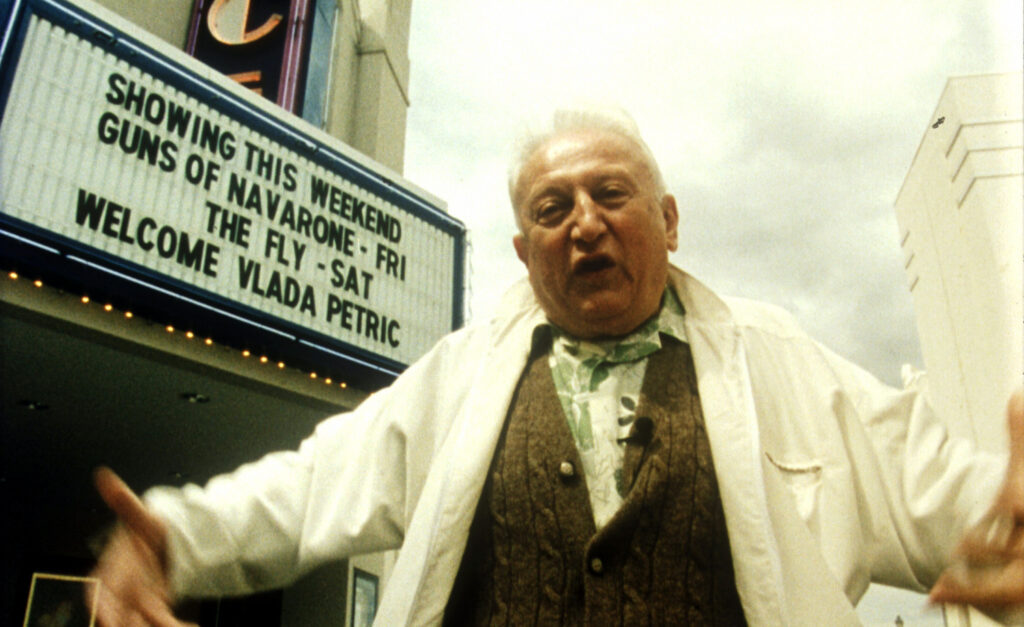
I have argued elsewhere that moving from the fringe to the mainstream is the inevitable fate of all innovators, regardless of the art form in question. Due to the endless adaptability of the marketplace in absorbing and then exploiting any and all comers, everyone, no matter how atonal, surreal, disjointed, minimalist, abstract, obsessive, dull, demented or just plain weird, winds up on TV, the internet or college, being admired, critiqued, imitated and dissected. And with his latest, Bright Leaves, McElwee comes full circle. By hunting down and featuring segments of a forgotten fifties Hollywood melodrama which seems to have been drawn directly from the tragic downfall of his great grandfather’s tobacco manufacturing escapades, and weaving its temper-tantrum dramatics seamlessly into his study of North Carolina’s economic and psychic dependence on tobacco, complete with cancer sufferers sucking away as they slowly expire and the always-about-to-quit charming with their latest excuse, he evokes a suitably complex portrait of the whole life and death dynamic that’s a perfect fit for the contemporary, self-assured ‘hot doc’ audience, even managing a classic surreal sequence, where he interviews a film historian from a wheelchair as the subject pushes him up and down a street outside a film festival. Bloody brilliant, as they’d say in Britain, where Channel Four seems to have done more than its fair share of McElwee financing.
It would be hard to think of a contemporary documentarist who has not been influenced in some way by McElwee’s minimalist autobiographies. Other than those who influenced him; and that would be his teachers at MIT, Richard Leacock and Ed Pincus, whose 1982 Diaries would seem to have been a very personal inspiration for McElwee. Then come, according to various interviews over the years, Fred Wiseman, D.A. Pennebaker and the Maysles Brothers. No surprises there. Also Chris Marker, whose Sans Soleil, is “a film you have to notice as a filmmaker, you have to come to terms with it”. Also predictable. What you might enjoy hearing is that Michael Moore contacted him during the making of Roger and Me, professing a love for the style of Sherman’s March and expressing a wish to make something similar but with more political clout. Well, we know what happened there: the clout quickly clobbered the art.
These days McElwee has experimented with digital video -two shorts on artists and art curators, Kosworth (1997), Boston Arts Academy (1999) and Curating (2002)- and like everyone else, is thrilled with its compactness, accessibility and economy, but still finds himself longing for the “discipline imposed by the cumbersome 16mm hand-helds with their ten minute film rolls”. He also thinks fondly of his two super-8 toting uncles who recorded every family get together for decades, pretty much setting the stage for the camera-as-memory-aid for the young McElwee. Part tip-of-the-hat and part family tradition, he records the growth of his son much as they provide childhood video clips for him to repeatedly masticate.
I have lived with Ross for some time now. It has been a pleasant but challenging end of summer project. Charming and irritating in equal measure. But the honeymoon is over and I look forward to reassuming ownership of my perceptions.
Originally published in Vol. #1, Issue #20, “Independent Voices”. Since this article originally appeared in these pages, Gordon Phinn has included it in his marvellous collection of writing, It’s All About Me: how criticism mirrors the self, which can be purchased through the link at Amazon.
Gordon Phinn

Gordon Phinn has been active as writer since 1975, his first book Lyrical Shifts being issued that year. Many chapbooks and books since, both literary and metaphysical/esoteric. Amazon has the most complete listing. His blog is at https://www.anotherwordofgord.wordpress.com, video blog at www.YouTube.com/thewordofgord. His Instagram portal is FineOldPhinn More recently his work has appeared on Reality Unmasked, The InnerVoiceMagasine, The Seaboard Review, The Miramichi Reader and the Asemana Journal. His Facebook pages Gordon Phinn and Gord's Poetry Show contain many links to current essays, poems and sundry points of interest.