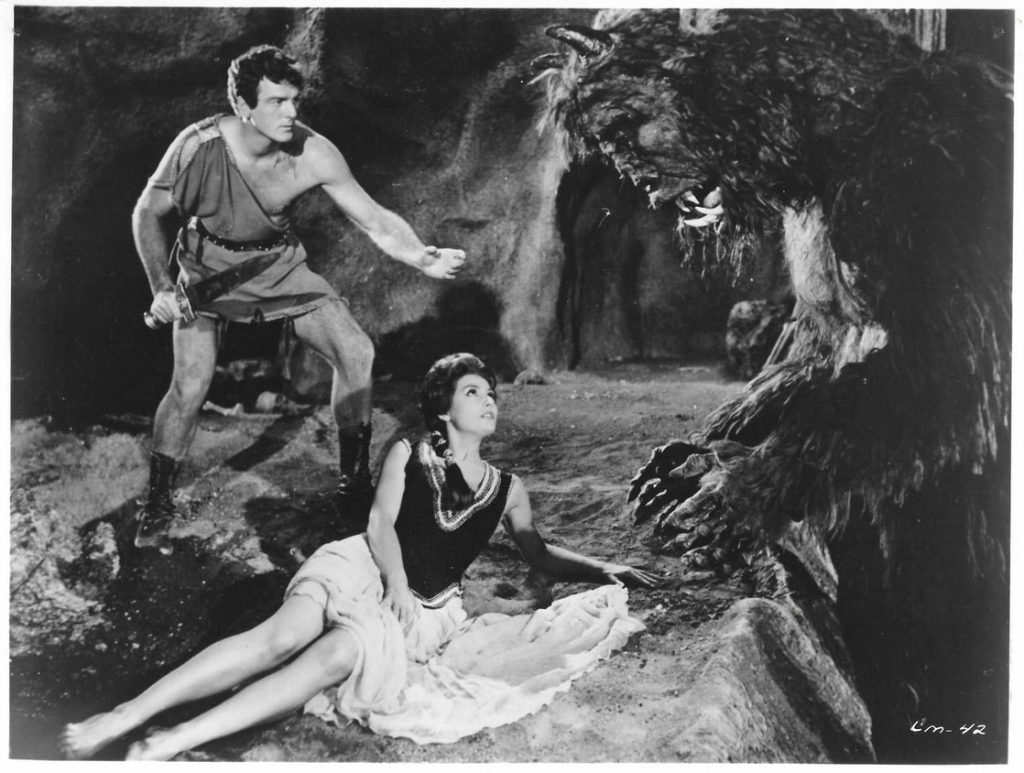
Minotaur, the Wild Beast of Crete (Italy, 1960) 95 min color DIR: Silvio Amadio. SCR: Gian Paolo Callegari, Sandro Continenza. PROD: Giorgio Agliani, Gino Mordini, Rudolphe Solmesne. MUSIC: Carlo Rustichelli. DOP: Aldo Giordani. CAST: Bob Mathias, Rosanna Schiaffino, Alberto Lupo, Rik Battaglia, Carlo Tamberlani, Susanne Loret, Nico Pepe, Paul Muller. (United Artists)
In the past two decades, great efforts have been made to restore Italian genre films like spaghetti westerns, gialli and horror, to their original lengths and proper aspect ratios. And perhaps the last European genre still requiring such attention is the peplum (Italian sword-and-sandal, muscleman epics). Too many of these pictures are only seen here today in crummy pan-and-scan TV prints, which undermine their achievements. Therefore it is a delight to see this in its 2.35 aspect ratio, with good colour. While this not a major film of the genre (though fans will want to see it anyway, diehards that we are), it gives evidence to the kind of spectacle we could expect if these movies were ever restored properly. This print is English dubbed, however some short scenes are in Italian (with English subtitles), suggesting that we’re seeing the film in its full intended version, as Italian films were shot silent: some scenes would be cut for North American distribution, therefore never dubbed in English.
Among the American athletes and bodybuilders like Steve Reeves or Gordon Mitchell who came to Italy to make peplum pictures, along comes two-time Olympic Gold Medalist Bob Mathias (previously playing himself in The Bob Mathias Story), for his one and only sword-and-sandal epic, as Theseus. (The film’s Italian title directly translates as: Theseus against the Minotaur.) The Minotaur lives in the caves beneath the royal palace on the island of Crete. Virgin women are periodically sacrificed to the beast for prosperity. While Queen Pasiphaë lies on her deathbed, she reveals to her husband King Minos (Carlo Tamberlani) that their daughter, the wicked Princess Phaedra, actually has a twin sister, Ariadne, who was spirited away to avoid being sacrificed to the Minotaur. Her last wish is for the sisters to share the throne, but Phaedra will have none of that, and sends her flunky Chirone (Alberto Lupo) and his men to the Greek village where Phaedra now lives, oblivious to her heritage, with orders to kill her. Theseus and his friend Demetrio (Rik Battaglia) happen to pass by when the slaughter of the village is under way, and rescue Adriane. Her foster parents are killed in the carnage, so Theseus offers that she could stay with his father.
Once Phaedra is informed of Adriadne’s rescue, she orders soldiers after the bunch. Adriadne is captured, Demetrio is killed, and a wounded Theseus falls into the ocean. Then comes the hilarious subplot where Theseus is rescued by the sea goddess Amphitrite (Susanne Loret) and her mermaids, seen with the lovely blonde actress superimposed over undersea footage to give the illusion that she can talk and breathe in the water. Amphitrite falls in love with Theseus, and offers him a lifetime with her beneath the sea, but he chooses to go to free Adriadne, who is now imprisoned by her evil sister, as food for the hungry hyenas!
Truly, Bob Mathias attains less than mythic screen presence as Theseus. To be fair, his role is that of a mortal (a point referenced in the mermaid scene): neither he nor Demetrio generate much excitement in their roles, where there is barely enough material for one. The dynamic rests between the diabolical Phaedra and Chirone.
Most films featuring twin characters on opposite sides of good and evil have the inevitable showdown between the two with over the shoulder shots or unconvincing doubles. Instead, the novelty here is that one sister must disguise herself as the other once the drama escalates. The fetching and (first-billed) Rosanna Schiaffino scores in playing both the wicked Phaedra and the demure Adriadne with equal conviction: succeeding far more than Maria Montez in her similar dual role in Cobra Woman.
Save for the pre-credits stinger, the Minotaur is barely seen until the final 15 minutes, when Theseus battles the creature in its underground lair. The early makeup work by Carlo Rambaldi (later of some flick called E.T.) is corny but creative – the beast is seen towering over our hero in a two-shot, just so you know that Bob’s not sparring with a bearskin rug. I’m sure kids in the Saturday matinee would’ve been thrilled by the monster, but in truth, I kind of felt sorry for the thing. Maybe that was the point – who knows?
And speaking of Carlo Rambaldi, it’s always fun to examine the credits of vintage European genre films, as you never know who is going to appear before or behind the camera! In this case, future directors attain some production credits: Alberto De Martino, who did several pepla and crime films, was an associate director; before directing such classics as Son of Django or Le Mans: Shortcut to Hell, Osvaldo Civirani had worked on 200 films including this one, as a still photographer. This mild good time is greatly enhanced by the widescreen presentation. The action scenes are okay, but the production is very handsome, with good art direction: many monochromatic scenes in variations of blue and green.
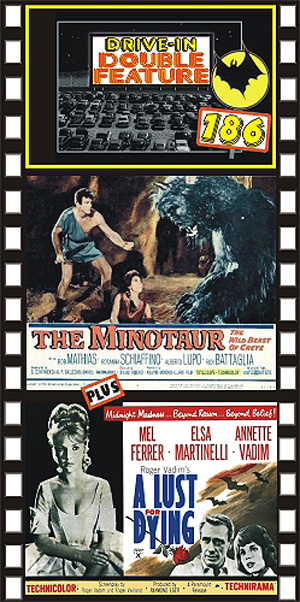
This film is featured on Vol. #186 of Sinister Cinema’s ever-popular Drive-In Double Feature series, paired with a French-language version of Roger Vadim’s A Lust for Dying (better known over here as Blood and Roses), on a single DVD-R. The disc opens with trailers, and a collection of intermission bumpers between the two films. In keeping with the theme of this film, one greenish trailer is for 1960’s Tarzan The Magnificent, featuring Gordon Scott, who would soon be a peplum star in his own right. Fittingly, this trailer seems to tie into the sword and sandal market with intertitles claiming that Tarzan has “The Courage of Hercules” and “The Strength of Samson”. Other trailers include the immortal Steve Reeves in Morgan the Pirate, and something called African Slave Girls.
Greg Woods

Greg Woods has been a film enthusiast since his teens, and began his writing "career" at the same time- prolific in capsule reviews of everything he had watched, first on index cards, then those hardcover dollar store black journals, then an old Mac IIsi. He founded The Eclectic Screening Room in 2001, as a portal to share his film love with the world, and find some like-minded enthusiasts along the way. In addition to having worked in the film industry for over two decades, he has been a co-programmer of films at Trash Palace, and a programmer/co-founder of the Toronto Film Noir Syndicate. He has also written for Broken Pencil, CU-Confidential, Micro-Film, and is currently working on his first novel. His secret desire is for someone to interview him for a podcast or a DVD extra.