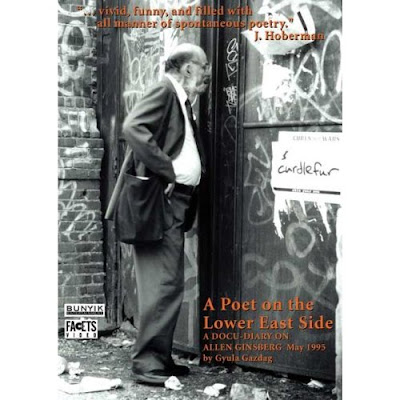
A Poet on the Lower East Side: A Docu-Diary on Allen Ginsberg May 1995 (USA-Hungary, 1997) 96 min color DIR: Gyula Gazdag. DOP: Marina Goldovskaya. CAST: Allen Ginsberg, Istvan Eosri, Peter Orlovsky, Gregory Corso, Jonas Mekas. (Facets)
In 1995, Allen Ginsberg’s Hungarian translator, Istvan Eorsi, travelled to New York for several days to meet with the legendary poet-activist-prankster to check on his latest body of work. The two men were followed around by director Gyula Gazdag (perhaps best known here for his splendid black and white film, A Hungarian Fairy Tale), and two cameras. The result is an endlessly fascinating look at the ghosts of the past.
At first, the film is a bit off-putting, as there is really no traditional beginning with salutations. We open quite abruptly in Ginsberg’s apartment with the two men going over sheets of poetry, with the shaky camcorder histrionics of America’s Funniest Home Videos, instead of feeling like a “film”. But in short order, the direction and camerawork become more assured, as if this small group charted out a more clear purpose for the next few days. As a result one feels this project becoming more alive, and it is exciting to watch.
While we do see some candid footage of the two men at work, discussing Ginsberg’s poetry, the ulterior motive of this film is a travelogue of Ginsberg, with Eorsi close by, visiting the remnants of the poet’s legacy in New York City. Each day of Eorsi’s visit begins with a title card summarizing the day’s events that we are about to see. The effect is much like the diary films of Jonas Mekas, who is also featured prominently in this picture.
In this travelogue, we also witness such luminaries as Ginsberg’s companion Peter Orlovsky and fellow Beat Generation poet Gregory Corso (who is in his element here). But even more movingly, Allen Ginsberg takes the camera crew (and ultimately, the viewer) on a tour through the monuments of the great struggle for change that he and his contemporaries underwent in the tumultuous 1950s. We witness the old jazz club where Charlie Parker played near the end of his life, former beatnik cafes, buildings where Ginsberg had protested to decriminalize marijuana, among other landmark relics. In fact, the long travelling shot which follows Mekas through the basement of Anthology Film Archives, with rows upon rows of film cans, seems also pertinent to this theme, as we remember the great adversity Mekas had experienced back in the day to show these controversial underground films. And to remind us that the struggle for change continues, we also witness some excellent footage when Ginsberg and the filmmakers encounter a squatter’s demonstration.
As such, the film ends as abruptly as it began, with no traditional goodbyes. Like a diary entry, the film closes with the activities of the final day– no great resolutions… his life and work will continue on.
It is re-assuring to hear Ginsberg, almost 70, still hang on to his ideals of social change. And he is certainly among the most important voices of the past century– few other figures in popular culture have spoken to as many generations as he, from the beatniks to the hippies, from the punks to the Gen X’ers… he is a saint to them all.
Greg Woods

Greg Woods has been a film enthusiast since his teens, and began his writing "career" at the same time- prolific in capsule reviews of everything he had watched, first on index cards, then those hardcover dollar store black journals, then an old Mac IIsi. He founded The Eclectic Screening Room in 2001, as a portal to share his film love with the world, and find some like-minded enthusiasts along the way. In addition to having worked in the film industry for over two decades, he has been a co-programmer of films at Trash Palace, and a programmer/co-founder of the Toronto Film Noir Syndicate. He has also written for Broken Pencil, CU-Confidential, Micro-Film, and is currently working on his first novel. His secret desire is for someone to interview him for a podcast or a DVD extra.