
The Immortal Story (France, 1968) 63 min color DIR: Orson Welles. PROD: Micheline Rozan. SCR: Louise de Vilmorin, Orson Welles, based on the story by Karen Blixen. DOP: Willy Kurant. CAST: Orson Welles, Jeanne Moreau, Roger Coggio, Norman Eshley, Fernando Rey.
Note: this piece is in need of an update (you’ll see why), but I’ve included it as is for now, as I think it’s kind of cute.
After more than a quarter century since his passing, the canon of actor-director Orson Welles is still being restored to its deserved glory: Othello was re-mastered and re-synced; his aborted documentary It’s All True was posthumously stitched together as close as possible to his intentions; and Touch of Evil was likewise restored to his original notes as much as the existing footage allowed (chiefly, no credits rolling over his famous opening shot). Plus, it seems that every few years one gets another tantalizing report that they’re getting closer to releasing The Other Side of the Wind, shot but never edited, once they settle legal matters with his daughter. (Not that I’m holding my breath over that one, but it would be nice to finally see it in our lifetime.)
Orson Welles’ career is full of uncompleted works, or films that were taken away from him and cut to someone else’s specifications. Still, one of Welles’ final (completed) works as a director is equally worthy of our attention and care. The Immortal Story (1968) is a coda to his work on both sides of the camera, and sadly, it is lacking the audience it deserves. As of this writing, it has never been released on video or DVD in North America. For a Welles retrospective in the year 2000, the Toronto Cinematheque could only present a rare screening of this movie in a horribly scratched, out-of-sync film print imported from Europe. (And in a previous retrospective, they only received the soundtrack!) Fortunately, this does play occasionally on TCM, in a gorgeous colour print with its original aspect ratio; but, this is a movie that cries for a Criterion treatment.
The Immortal Story may not be The Dead Sea Scrolls a la Bresson’s Les Affaires Publiques (a nearly lost early film which turned out to be a major revelation in light of his subsequent career) nor is it an odd duck a la Lang’s Liliom, made in that director’s stopover in France while fleeing Nazi Germany en route to America. One could easily overpraise it due to the elation of finally getting to see it. Instead, The Immortal Story recalls such work as Othello or Mr. Arkadin– where moments of genuine brilliance dot the otherwise fledgling production. Yet, this smaller picture is superior to either of those, and is certainly more personal.
The Immortal Story is another of the far too many “would be”s in Welles’ career. This was the first (and subsequently, only) half of what was to be a two-part work based on the writings of Karen Blixen (the second would have been The Deluge at Norderney), whom Welles greatly admired.
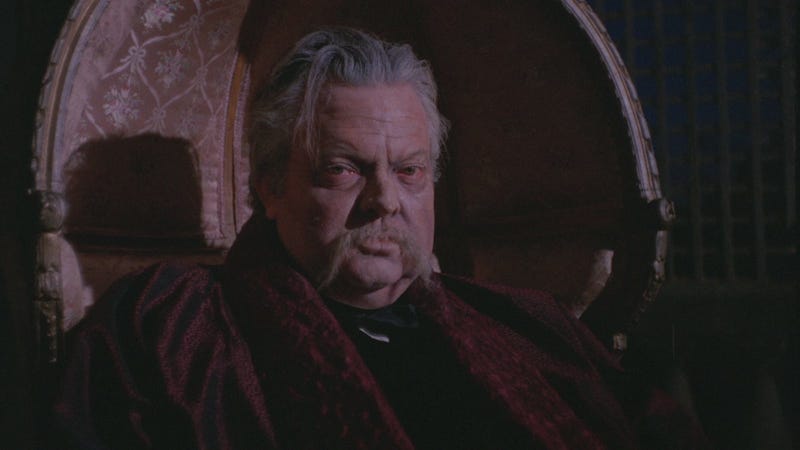
In addition to writing the screenplay adaptation, and directing the five-week shoot for French television, Welles also cast himself as Mr. Clay, the septuagenarian rich man in Macao who begins to tell his clerk Levinsky (Roger Coggio) the story of a sailor who is paid to conceive a child with a rich old man’s young wife, only to learn that he too knows this oft-heard tall tale. Thus, Clay decides to turn this fable into a reality by having Levinsky hire a woman to play his wife (for he is unmarried) – and then finds a poor sailor, Paul (Norman Eshley), to do the deed- for five guineas- one-sixtieth of what the girl, the ironically named Virginie, is paid! This is a gambit for a soul, and ultimately, Clay loses, dying at dawn before he truly understands matters of the heart. He also loses his gambit to flex his power: the sailor would be the only one to tell this familiar story with the verity of having done it, therefore he is passing on something Clay has created. However, the sailor (actually, he was the virgin of the coupling) decides not to tell anyone of the matter. (“Who would believe me?”) The only child Clay could create was the story, and it is stillborn.
This film was shot just after actor-director Welles’ Shakespearian omnibus Chimes at Midnight, once again employing his co-stars Jeanne Moreau as Virginie (she had also appeared in his adaptation of Kafka’s The Trial), and Fernando Rey in a bit part as a villager who participates in ill gossip about Clay.


There are threads extant in this summary that are common in Welles’ canon: the exploitation of power, the unloved mighty one, and the deception of narrative. The Clay character is an interesting mixture of Charles Foster Kane, Mr. Arkadin and Hank Quinlan. Kane once said, “If I wasn’t rich, I might’ve been a great man”. The rosebud of Citizen Kane is of a time when wealth didn’t corrupt him (or, for that matter, when his wealth did not corrupt others) and when he actually knew love. Immortal Story is Kane in reverse- he is using wealth to corrupt others before obtaining his (ultimately intangible) Rosebud.
As does Mr. Arkadin, Clay exploits his power so that those in his web merely become pawns. Arkadin hires a young man to uncover a fact of his past, mainly to see how he performs in the game Arkadin orchestrates- certainly Paul and Virginie are playthings to Clay (he is living love vicariously, and as a surrogate), as is the clerk who acts as ringmaster- note the scene where we see the small room lived in by a man who works for a millionaire: it is shot Dutch angle from the exterior- he is a man in a pen. In this quartet of Welles’ characters, perhaps Hank Quinlan (from Touch of Evil) is the most honourable- he is corrupt, but he abuses his power to ensure that justice prevails. Like Quinlan, Clay at least attempts to be human: Arkadin and Kane had forgotten how.
While even at 63 minutes, The Immortal Story is slow-going, but there is much to enjoy in this project. This is the first Welles feature to be shot in colour. Cinematographer Willy Kurant (who had just shot Agnes Varda’s The Creatures, and Jean-Luc Godard’s Masculin Feminine) uses colours boldly and selectively, as in the dinner scene between the sailor and Clay, where the impoverished lad is awash in amber (suggesting vitality), while Clay is in muddy blue (suggesting, as author Charles Higham puts it, the character’s sexual impotence). The seduction scene is filmed in soft focus to suggest a sensual mood, but the prevailing palette of over-accentuated whites lends the moment a proper coldness.

For the music, Welles sparingly uses pieces by Erik Satie, played by Aldo Ciccolini. “Trois Gymnopedies” underscores one of Jeanne Moreau’s early scenes, and more effectively, “Trois Gnossiennes” is used in the striking final shot, a long take featuring the chair (with its back to the camera) with Clay’s dead body in the right foreground, the clerk in middle ground and mid-frame looking at the chair, and in the background on left of frame, Virginie looks offscreen. All the characters are strategically placed like pawns (including Clay- he designed the game then played it). The chamber music perfectly compliments the geometry of the frame, and the coldness of the mood.
In hindsight (and for now, until the day in which we may at last see The Other Side of the Wind), this film is perhaps the coda of actor-director Orson Welles. Although his subsequent film F for Fake, featuring Welles as himself, uses a favourite theme of puzzles, as the entire film is about the fun had while being had in its deceptive narrative, The Immortal Story extrapolates more of Welles’ themes with characters. Clay is another classic Welles character under his own direction; he is another interesting variation on a favourite protagonist: a giant of a man who with the growth of power and wealth, has subsequently drifted further apart from humanity.
The Immortal Story is also, sadly, indicative of many projects made by that giant of a man behind the camera. It is unfortunate that the careers of those who wrote cinematic language (Welles, also with Griffith and Eisenstein), are plagued with missed opportunities and interference from third parties which otherwise would have made their bodies of work even more aspirational.
This film went to television in France (and quickly vanished) and its ensuing international theatrical distribution never happened. While other later period films, like F for Fake and Chimes at Midnight, have been remastered and restored, The Immortal Story is equally deserving of that attention. Despite that it is another of too many Welles films where the aspirations exceeded the result, where his flourishes hint at how much more the movie could have been, it is nonetheless essential viewing.
Originally published in Vol. #1, Issue #24. Since then, Criterion has released both Chimes at Midnight and The Immortal Story to DVD. And at last, The Other Side of the Wind was made available in 2018.

Greg Woods

Greg Woods has been a film enthusiast since his teens, and began his writing "career" at the same time- prolific in capsule reviews of everything he had watched, first on index cards, then those hardcover dollar store black journals, then an old Mac IIsi. He founded The Eclectic Screening Room in 2001, as a portal to share his film love with the world, and find some like-minded enthusiasts along the way. In addition to having worked in the film industry for over two decades, he has been a co-programmer of films at Trash Palace, and a programmer/co-founder of the Toronto Film Noir Syndicate. He has also written for Broken Pencil, CU-Confidential, Micro-Film, and is currently working on his first novel. His secret desire is for someone to interview him for a podcast or a DVD extra.