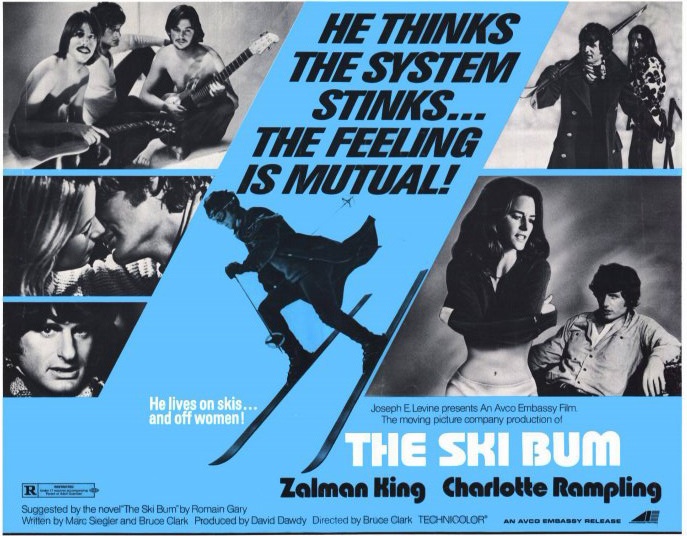
The Ski Bum (USA, 1971) 95 min color DIR: Bruce Clark. PROD: David Dawdy. SCR: Bruce Clark, Marc Siegler (“suggested by the novel of Romain Gary”). MUSIC: Joseph Byrd. DOP: Vilmos Zsigmond. CAST: Zalman King, Charlotte Rampling, Joseph Mell, Dimitra Arliss, Michael Lerner, Penelope Spheeris, Jackson Browne, Ned Doheny (Stoned Guitars). (Avco-Embassy)
From the late 1960s to the early 1970s, Hollywood was still run by aging moguls, who nonetheless were so out of touch with the long-haired baby boomers, that they would bankroll practically anything that had even the most vague references to the counterculture generation or the themes that it embraced. It truly was a magical time where the only rule was that there were no rules, and as a result countless movies, big and small, were made which captured that restless, freewheeling spirit. Granted, many of those films are imperfect (some badly dated), yet that imperfection is often the price paid when striving for something of higher enlightenment. And even so, warts and all, these scruffy, stuttering, wildly uneven opuses from those years have a certain vitality to them that one usually misses in today’s antiseptic mainstream cinema, and that is why people like myself want to see every damn one of them.
I mean, whenever else in film history will you hear a dialogue like: “I just killed your dog.” “The poodle? Outta site! Come on inside for a drink.”?
If for nothing else, The Ski Bum is a valuable relic of that wrinkle in time, when unconventional approaches to moviemaking could still be embraced by the mainstream. It was a joyous winter day when I discovered that one of my favourite independently owned video stores had this film for rent on the shelf, even if it was only a DVD-R: I was elated by being able to see the film after years of curiosity spent over Leonard Maltin’s capsule review in his annual movie guide, especially because he gave it the BOMB rating. (Any 70s film that he’d rate BOMB or *1/2 stars would instantly command my attention, because usually these movies would at least be unique, despite or because of their flaws.)
Although some sources (Maltin’s included) say that this runs for 136 minutes (and I couldn’t imagine how), the copy I’ve screened plays for 95 minutes (and it’s amazing it takes even that long to say what little it has to). This scenario (“suggested” by Romain Gary’s novel of the same name, whatever the hell that means) is about Johnny Cochrane (Zalman King), a moody ski instructor whose high-class girlfriend Samantha (played by the ravishingly mysterious Charlotte Rampling) works for a shady aristocrat. At first her boss hires Johnny to provide skiing lessons to his two monster children (seeing him on the slope dressed in a black trenchcoat instead of a jumpsuit makes him the most peculiar skiing instructor ever), yet before long Johnny begins doing other suspect tasks for the boss, including buying dope from some of the most exaggerated hippie stereotypes ever seen in a so-called mainstream movie.
On the surface, Johnny is the typical cultural misfit familiar to many protagonists of 1970s cinema, who rejects the status quo yet cannot find roots anywhere else, either. Similarly, Johnny tries to avoid the high-class society that welcomes him into their orbit, preferring to be his own man, yet eventually panders to it once he realizes he’s nothing without it. The throwaway line in which Samantha asks him, “You’re a Gemini, aren’t you” is perhaps the most telling, suggesting a conflicting, dual personality: certainly Johnny is unpredictable- gentle one moment, screaming his head off the next. (And while I confess to liking Zalman King’s screen presence, he’s much better quiet, and grating when he’s intense.)
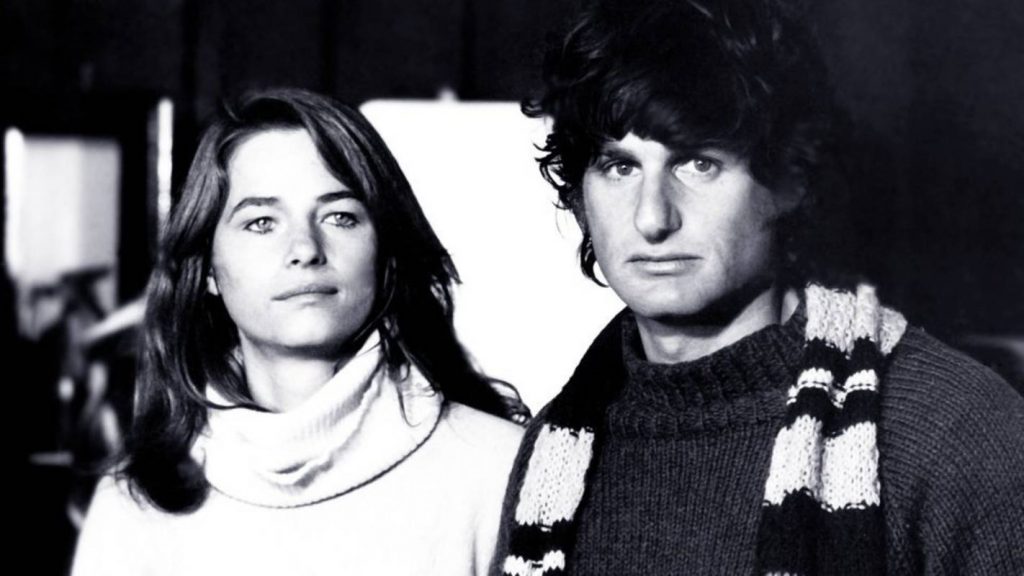
Whatever political undertones may exist in Gary’s novel (based upon the synopsis I’ve read) are practically transparent here, however this filmic “suggestion” is about class structure. There are always blockades to his entrances into Samantha’s world of leisure and cocktail parties (he is constantly hounded by doormen), until she personally allows him in. Ultimately, Johnny realizes he can’t live with or without them.
And while the movie may have had commercial appeal alone for its fashionably confused, aimless protagonist, the filmmakers decided to make the movie a bit more hip (for better or for worse) with such psychedelic effects as echoing voices on the soundtrack to suggest how everyone is smothering Johnny. Even more negligible is the steam bath sequence, in which cinematographer Vilmos Szigmond overexposes the scene to hot whites, suggesting that it is all a fantasy scene in which all the characters intertwine, with revealing dialogue that further explores Johnny’s psyche, that however turns out as Fellini on a bad day. There is even the old “movie within a movie” gimmick, in which our heroes are besieged by hip young filmmakers who are shooting something called The Ski Bum: this once innovative layer exploited only a few years earlier by the French New Wave was already old hat by 1971.
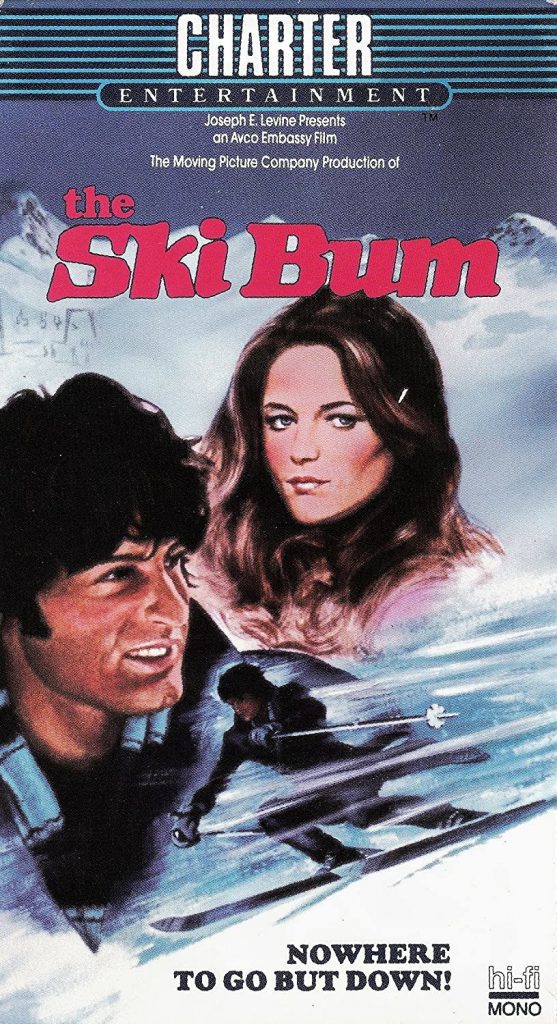
Updated from a review originally published in Vol. #1, Issue #16. (As of this writing, The Ski Bum, like many of Joseph Levine’s films, is not available on DVD. The DVD-R I watched may have been sourced from the original Charter Entertainment VHS, which released many of Levine’s films through Avco Embassy, which are still MIA in digital format.)
Greg Woods

Greg Woods has been a film enthusiast since his teens, and began his writing "career" at the same time- prolific in capsule reviews of everything he had watched, first on index cards, then those hardcover dollar store black journals, then an old Mac IIsi. He founded The Eclectic Screening Room in 2001, as a portal to share his film love with the world, and find some like-minded enthusiasts along the way. In addition to having worked in the film industry for over two decades, he has been a co-programmer of films at Trash Palace, and a programmer/co-founder of the Toronto Film Noir Syndicate. He has also written for Broken Pencil, CU-Confidential, Micro-Film, and is currently working on his first novel. His secret desire is for someone to interview him for a podcast or a DVD extra.