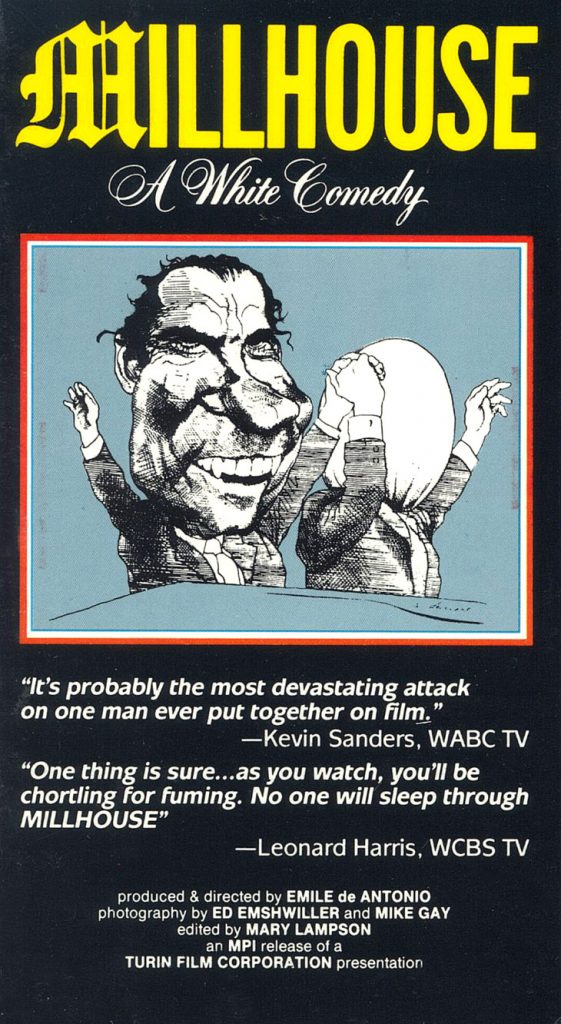
Millhouse: A White Comedy (USA, 1971) 92 min B&W DIR-PROD: Emile de Antonio. DOP: Ed Emshwiller, Mike Gay. EDITOR: Mary Lampson. (New Yorker Films)
With the infamy surrounding Michael Moore’s Fahrenheit 9/11, it is perhaps the proper time to look back on the career of another documentary filmmaker: a troublemaker that took on the administrations of his day. Emile de Antonio’s trailblazing films upset the status quo during his reign in the 1960s and 1970s. A self-described “Marxist among Capitalists”, de Antonio made documentaries which took potshots at politics or accepted societal truths, often by editing previously-shot footage (and without narration, which he considered as “inherently Fascist.”) His first feature, Point of Order (1964), is a hilarious decoupage of the televised McCarthy trial. He further tapped into the American psyche with Rush to Judgment (1967), which questioned some of the accepted truths about the JFK assassination, and then In the Year of the Pig (1969), which spoke to the anti-Vietnam activists throughout the land.
Millhouse: A White Comedy (1971) was a film that could be called “ahead of his time”. This feature, assembled from archival footage over the span of two decades, de-glamourizes Richard Nixon… before Watergate did that for him. Seeing this years later, we of course have the advantage of hindsight to note the ironies of this depiction of the former president. We see Richard Millhouse Nixon as an opportunist, exploiter, and two-faced, and yet we also see him as nakedly human. Yes, all humans are imperfect, but it is another thing to see a public figure of such stature allow his flaws to be worn on his sleeve.
The famous saying, “You won’t have Richard Nixon to kick around anymore”, after another in a string of his resignations from public office, may have about as much credibility as a “Farewell Tour- We Really Mean It This Time” by The Who. However, we learn that even this seeming oafish behaviour is part of a master plan.
There is a telling, lengthy sequence of Nixon’s public address about the Hughes loan, in which he offers the viewer a meticulous breakdown of his spending habits, thereby challenging his opposition’s allegations over where the money goes to and from. In this hilarious piece of historical propaganda, Tricky Dick muses about the modest lifestyle of the Nixon family: his wife Pat doesn’t have a mink coat, but she does have a Republican coat “and she looks good in it”; the family goes around in a 1950s Oldsmobile, and in light of the accusations of receiving payoffs, he confesses that, yes, they did receive one gift, a dog for his daughter. And since the Nixon’s do not have a pet, “we’re going to keep it”.
One may remember the famed presidential debate between Nixon and JFK. Those who heard the debate on the radio were convinced that Nixon won the debate. Those who watched it on television were convinced that JFK won it, because visually he came off more as a proper embodiment of what a president should look like, especially as Nixon disappeared into the backgrounds due to his similarly coloured wardrobe.
The point to be made from this off-topic example is, that throughout Millhouse, talking heads attest to Nixon’s lack of personality- for instance, we see a man who went to college with Nixon in the 1930s who cannot relate a single anecdote about him in their school days. Yet we see just how calculating is this man who seems to disappear into the background. For instance, this long unbroken scene in which Nixon defends his spending habits seems to embody this contradictory personality. Here is a man who is willing to undergo public embarrassment just to make his point- he is like a dog that is always trying to do tricks to impress its master enough to divert attention away from the cute poodle in his or her lap. (After all of his political defeats, he vows never to return, yet always does, just like that poor dog craving attention.)
Yet, truthfully, Nixon is fully aware of such an image: at one pivotal moment in this endless spending tirade, he gets up from behind his desk and goes right to the camera for that grand final statement: “Why am I doing this? Because I love my country.” This subtle moment relates to his golden retriever personality sucking up to Ike Eisenhower, sharing that man’s views on “Communists everywhere”, and yet Nixon would milk the public’s fears of Communism to such a degree that he would gain public sympathy for himself. In fact, when Eisenhower has a heart attack, Nixon grossly uses the man’s frail image to promote himself as Ike’s successor.
One needn’t have an explicit knowledge of politics to enjoy Millhouse, because it is more an exploration of a man than a career. Perhaps the Watergate scandal has taken the sting out of this film somewhat, even though one admires de Antonio’s foresight to have made such an indictment of a public figure beforehand. One comes away from this picture perhaps knowing less about Nixon, due to his contradictory nature: a man tries to show how much more human he is than anyone else, yet in a profession that is usually larger than life.
Excerpted from an article on Emile de Antonio, originally published in Vol #1, Issue #14, (“Back to the 70s”). The review of this film was made possible from its previous issue on VHS. Since then, Millhouse has been released in a four-film DVD set: Emile de Antonio: Films of the Radical Saint.
Greg Woods

Greg Woods has been a film enthusiast since his teens, and began his writing "career" at the same time- prolific in capsule reviews of everything he had watched, first on index cards, then those hardcover dollar store black journals, then an old Mac IIsi. He founded The Eclectic Screening Room in 2001, as a portal to share his film love with the world, and find some like-minded enthusiasts along the way. In addition to having worked in the film industry for over two decades, he has been a co-programmer of films at Trash Palace, and a programmer/co-founder of the Toronto Film Noir Syndicate. He has also written for Broken Pencil, CU-Confidential, Micro-Film, and is currently working on his first novel. His secret desire is for someone to interview him for a podcast or a DVD extra.