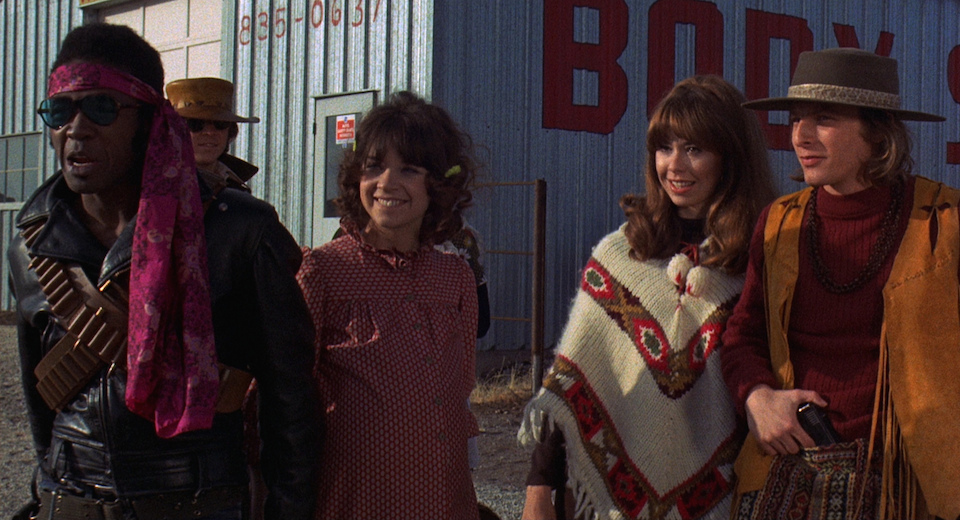
Gas-s-s-s, Or It Became Necessary to Destroy the World in Order to Save It (USA, 1970) 79 min color DIR-PROD: Roger Corman. SCR: George Armitage. MUSIC: Country Joe and the Fish, Barry Melton. DOP: Ron Dexter. CAST: Robert Corff, Elaine Giftos, Bud Cort, “Tally Coppola” (aka – Talia Shire), Ben Vereen, Cindy Williams, Alex Wilson, George Armitage, Pat Patterson, Country Joe and the Fish. (American International Pictures)
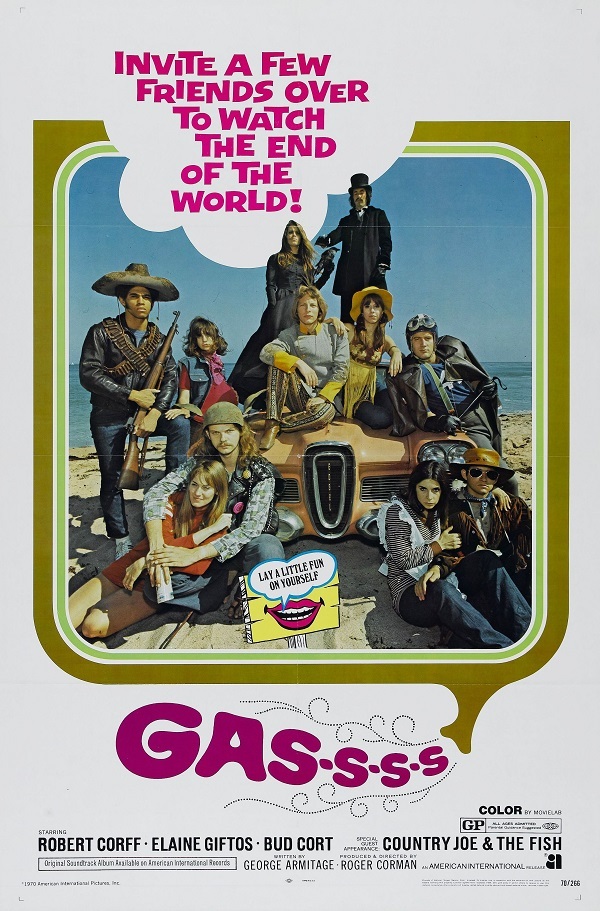
It is hard to write a review of this film, as we can only evaluate it on whatever merits remain in its mutilated form after Sam Arkoff and James Nicholson at AIP had their way with Roger Corman’s original cut. (This editorial decision was the last straw for the legendary director-producer’s long-standing association with American International Pictures. He then concentrated on producing from his own New World Pictures through the 1970s and 80s.)
The opening, done in animation, features a general with a John Wayne voice, and a senator cracking open a bottle, releasing a gas that destroys the adult population. Why would these old timers want to kill the adults? Why not the radical kids that they do not understand? Perhaps this point is lost in this recut version. Otherwise the screenplay by George Armitage (later a director of such genre-bending films as Miami Blues and Grosse Point Blank) is a playful allegory about how the young generation fares in a world where everyone over 25 (thus, anyone with any kind of authority) is dead. Among our group of survivors traveling the southwest are the hippie radical Coel (Robert Corff), his idealistic soulmate Cilla (Elaine Giftos), the black militant (Ben Vereen!), and a pregnant 60s record collecting freak (Cindy Williams- reminding us of her pre-Laverne & Shirley roles showing her knack for unconventional humour). Also look for Tally Coppola (AKA Talia Shire- “Yo Adrian!”) and Bud Cort in supporting roles.
In this post-apocalyptic world, they encounter subcultures that battle over material goods or male superiority, yet any scenes depicting combat are still juvenile in content. Our heroes have a gunfight with a gang of car thieves led by one Billy the Kid… no bullets are fired, yet everyone yells a cowboy name (from Randolph Scott to Lee Van Cleef) at the pull of the trigger. In another offbeat scene, they encounter bikers who ride in golf carts! All of the mayhem in this movie is approached with a curious innocence: even the female victims of sexual assaults treat the incidents like they’re no big deal. The latter moments are tasteless, but they do make sense- these youths really have no comprehension of the horrors of the adult world. Even the big climax of the picture becomes allegorical as the hippies and the macho goofballs fight for superiority in a football game (just like in M*A*S*H).
The great song score is composed by Country Joe and the Fish, who also appear in concert at a drive-in. (Oh, weren’t those the days?) But while people fornicate with the illumination of car headlights, Country Joe McDonald (who is probably incapable of doing a show without some kind of political agenda) delivers a speech about how everyone can come together and make the world a better place. Alas, his utopian message is soon lost, as we are grimly reminded of how the human race would continue to destroy each other. This film has symbolism and surrealism to spare, including (an in-joke reference to recent Corman) one character in a top hat on a motorcycle, named Edgar Allan Poe (screenwriter Armitage getting a colourful role), warning people of the Red Death. These ingredients do not properly come together, and somewhere this message gets muddled: however, one cannot blame the screenwriter or the director for this. Corman insists that the ending of the picture was cut off completely, as the movie mysteriously finishes after the magical re-appearance of all of the film’s bizarre characters, and the petty combat being interrupted by a lightning bolt from God, who apparently was a major character in the finale that ended up on the cutting room floor!
While obviously very disjointed, thanks to its post-production tampering (one can see that its 79-minute running time is not long enough), Gas-s-s-s, is more clever than not, and stands apart from many of the counterculture pictures of the time for taking an unconventional, existential approach to hippie idealism. Perhaps it reminds us how it was good thing that the hippies never ruled the world, but that too may be lost in the cutting.
Originally published in The Roger Corman Scrapbook.
Greg Woods

Greg Woods has been a film enthusiast since his teens, and began his writing "career" at the same time- prolific in capsule reviews of everything he had watched, first on index cards, then those hardcover dollar store black journals, then an old Mac IIsi. He founded The Eclectic Screening Room in 2001, as a portal to share his film love with the world, and find some like-minded enthusiasts along the way. In addition to having worked in the film industry for over two decades, he has been a co-programmer of films at Trash Palace, and a programmer/co-founder of the Toronto Film Noir Syndicate. He has also written for Broken Pencil, CU-Confidential, Micro-Film, and is currently working on his first novel. His secret desire is for someone to interview him for a podcast or a DVD extra.